Homepage | Christmas | The Adoration of the Shepherds: When the Angel Announced the Birth of Jesus
The Adoration of the Shepherds: When the Angel Announced the Birth of Jesus
1 December 2025
Reading Time: 5minutes
The Adoration of the Shepherds: from the Gospel of Luke to the Nativity Scene — an ancient yet ever-relevant story
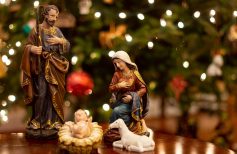
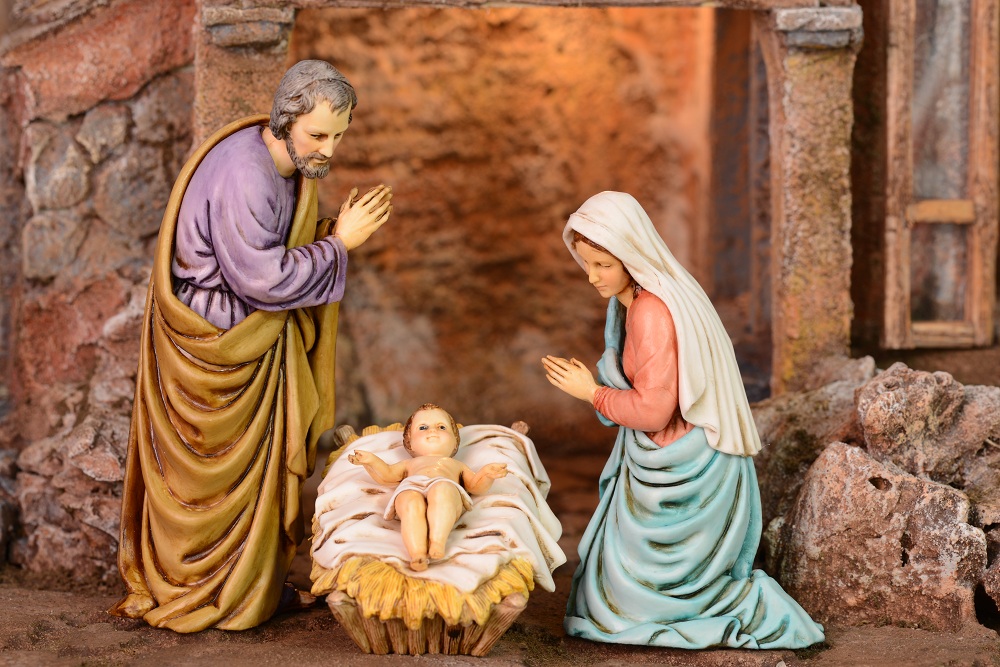
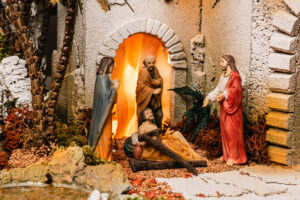
From childhood, we learn to recognise the main figures of the Nativity Scene: the Holy Family — Mary, Joseph, and of course the Baby Jesus — the ox and the donkey, whose task it is to keep Him warm in the manger, and the shepherds who come to witness the birth of Jesus. This is because the Adoration of the Shepherds is a fundamental episode not only within the context of the Nativity, but also in the broader story of the coming of Jesus into the world — His becoming man for mankind, at Christmas.
Christmas. This department is entirely dedicated to Christmas; here you will find a selection of all the Christmas articles in our catalogue such as…
What makes this episode — reported solely in the Gospel of Luke — so precious and significant is precisely the identity of its protagonists. The Son of God has just been born into the world; it is the beginning of the fulfilment of the divine plan, the start of the path that will lead humanity to the New Covenant and to Salvation.
In the Old Testament, God spoke to kings and prophets, to patriarchs and priests. Or He sent His messengers — His angels — to enlighten those who were to guide peoples and souls, to prepare the way for the coming of the Messiah. But in the New Testament, something begins to change.
Still in the Gospel of Luke, the Archangel Gabrielappears to Zechariah to announce that he will become a father despite his old age: from him and his wife Elizabeth will be born John the Baptist. Gabriel then visits Mary of Nazareth, asking her to receive the Son of God into her womb and to accept the destiny prepared for her. Afterwards, he appears in a dream to Saint Joseph, her betrothed, commanding him not to reject the girl but to protect and love her and the Child to come. Zechariah is indeed a priest, while Mary and Joseph are ordinary, humble people, though destined for great things.
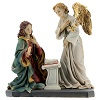
Annunciation Archangel Gabriel and Mary resin statue 16 cm. Scene representing the Annunciation with the Archangel Gabriel holding lilies…
Still in the Gospel of Luke (Lk 2:8–14) — the only one of the canonical gospels to mention the episode — we read how, to announce the birth of Jesus, God decides not to turn to scholars or men of power, to priests or prophets: He sends an angel to speak to poor shepherds camping out in the open with their sheep — men who, “keeping watch over their flock by night,” were sleeping outdoors. An angel appeared to them, and “the glory of the Lord shone around them.” The Angel said to them: “Today, in the city of David, a Saviour has been born to you; He is Christ the Lord. This will be a sign to you: you will find a baby wrapped in swaddling clothes and lying in a manger.”
Then, “a multitude of the heavenly host” joined him, singing the Glory of God. It is hard to imagine anything more revolutionary! Impossible to fathom the astonishment of these men, who possessed nothing but their flocks — unlearned, lacking the knowledge that others of higher rank possessed, those who had dedicated their lives to study. Luke tells us that “they were terrified,” and their fear is understandable before one — and then many — angels shining with light! Yet they obey at once, responding to the invitation without hesitation, and go, fearful yet determined, to see this very special Child.
Following the path shown to them by the Angel, “they found Mary and Joseph, and the baby, lying in the manger. And when they had seen him, they spread the word concerning what had been told them about this child.”
The episode ends with the shepherds returning to their work and to their lives, “glorifying and praising God for all the things they had heard and seen, which were just as they had been told.”
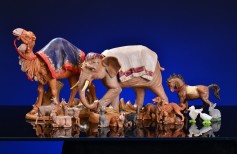
Nativity Scene figurines: terracotta, resin and wooden figurines. Here you can find Nativity scene figurines of different sizes…
Beyond the beauty of the Gospel narrative, its symbolic meaning is clear, and we can explore it in its different aspects. The very fact that the Angel’s announcement comes at night — the time when human beings are most exposed and vulnerable, the time of dreams, of reflection, of thoughts, fears, and choices — helps us understand that nothing is accidental in the divine plan. God sends the angel to announce the birth of Jesus at night, and He sends him to men who know nothing of Him — ordinary, simple, unworthy men. But that is how every human being is before encountering God, and it is natural that the shepherds’ reaction is one of wonder and fear.
The greatness of God overwhelms them; His light envelops them — not as something to behold from afar, but as something of which they become a part, an infinitesimal yet precious and irreplaceable part. Thus, the Son of God enters the world and the story of humankind — all those ready to believe, to receive the signs and messages of God, and to treasure them.
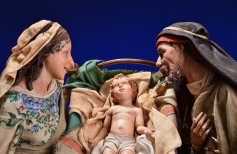
Baby Jesus figurines. In this department you can find a selection of plaster, wood, wood pulp and resin Baby Jesus figurines…
Later, the Wise Men will also arrive at the Nativity grotto. They symbolise the powerful, the learned — those who knew the prophecies and were aware of the coming of the Messiah. It will be their task to proclaim the birth of Jesus among their peers. But the first to adore the Child on the night of all nights will remain forever the humble shepherds visited by an Angel descended from Heaven.
Sacred icons: genuine expressions of religiosity, symbolic works that transcend art. How are they painted? Discovering egg tempera Much of...
2 March 2026
What’s the Future of Religion?
What’s the Future of Religion?
A Beginner’s Guide to Christianity
A Beginner’s Guide to Christianity
Mind-Blowing Statistics About Christianity You Need to Know
Mind-Blowing Statistics About Christianity You Need to Know
8308
Enter the Holyart world: $20 discount voucher valid on over 60,000 items
Come and discover Holyart, the largest e-commerce of religious articles in Europe and immediately receive a $20 voucher to use with your first purchase.
Check your mailbox: you will receive your discount within 5 minutes