Marriageas a sacrament instituted by God and Christ and therefore indissoluble by human hands was recognised between the ninth and tenth centuries. It is one of the seven sacraments of the Christian tradition. In particular, it is one of the Sacraments of the Church, which makes the faithful members active in the creation and propagation of the Church in the world, either as families or as Christian communities. It is not difficult to understand why it is so essential and inviolable, and why it is not possible to take the concept of marriage annulment lightly.
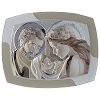
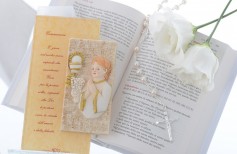
Here you can find gift ideas, favours, sacred icons and beautiful headboard rosaries.
In the sacrament of Matrimony, the union of Christ with the holy Church is celebrated. In this perspective, every union assumes connotations of a sacredness that transcends the human will. In the Catechism of the Catholic Church, we read that: “God is love and lives in himself a mystery of communion and love. Creating it in his image […] God inscribes in the humanity of man and woman the vocation, and therefore the capacity and responsibility of love and communion.” Capacity and responsibility are profound and strong concepts, especially in an age like ours, in which too often we tend to take things, even the most serious and important ones, lightly.
It is not for nothing that Jesus himself has pronounced on more than one occasion regarding the indissolubility of marriage and adultery. We find traces of His teachings in the Gospels and Letters of Saint Paul the Apostle.
Thus, Jesus says in Mark 10:6-12 to the Pharisees who ask him if it is lawful for a husband to repudiate his wife, invoking the act of repudiation granted by Moses: “… at the beginning of creation God created them male and female; for this reason a man will leave his father and mother and the two will be one flesh. and the two will become one flesh, so that they are no longer two, but one flesh. What therefore God has joined together, let no man separate.”
And shortly afterwards, in the same passage of the Gospel of Mark, he adds: “Whoever divorces his wife and marries another commits adultery against her; if the woman divorces her husband and marries another, she commits adultery.”
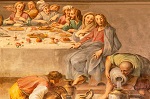
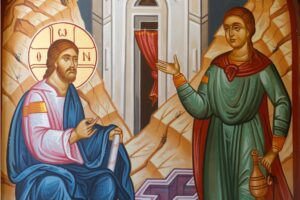
Jesus also recognises the seriousness of adultery, and yet, in John’s Gospel (John 8:1-11), we see how, in His infinite goodness and mercy, He is willing to forgive, provided there is on the other side the will not to sin anymore. So to those who would like to stone the poor woman and believe themselves to be without sin, he proposes to throw the first stone. And he says to her: “Neither do I condemn you; go and from now on do not sin anymore.”
Moreover, adultery is deplored in many passages in the Old Testament.
“Do not commit adultery” (Exodus 20:14) “Do not commit adultery” (Deuteronomy 5:18)
Divorce for the Catholic Church is only allowed in some instances. Let us look at them. Excluding the latter, if a man and woman married in church decide to separate, their marriage, as far as the church is concerned, will remain valid. If one of you enters into a new relationship, you will be an adulterer, and if you marry the new partner, you will live in sin and be excluded from the sacraments.
Given the indissolubility of the marriage bond, not even the Ecclesiastical Court can annul the religious marriage. However, it can declare that it was initially null and void, as if it had never been celebrated.
We consider that the annulment of the civil marriage means its cancellation. In fact, it will be as if it had never been celebrated, and all the effects produced by the marriage will be annulled retroactively.
This is not the case with religious marriage. Church and divorce don’t get along very well. To date, divorce between two Catholics only causes the termination of the civil effects of the conjugal bond. Still, if one of the two wants to marry a second time through a religious rite, they must apply to the Ecclesiastical Court. Nor does the Sacra Rota have the power to cancel a marriage. It can only certify its nullity, and only in rare cases. The Sacra Rota therefore recognises the nullity of marriage only if the causes prescribed by canon law exist, and only in this case are the spouses dissolved from rights and obligations and can remarry in the Church.
An ecclesiastical lawyer will evaluate the conditions for obtaining nullity and will deposit with the Ecclesiastical Court the libel, which describes all the events involving the couple from the engagement to the wedding. Hence, the process for recognising the ecclesiastical judgment of nullity of marriage.
In the event of the death of one spouse, the other may remarry in church in due course. In fact, for Catholics, the marriage bond ends only with the death of one of the spouses, as the formula says: “until death separates.”
The causes of the annulment of the marriage
The church recognises the nullity of marriage in the case, for example, of:
Error in the identity or quality of the spouse, which may fall on a quality of one of the two or may occur if a marriage is celebrated by proxy;
Marriage induced by violence or intimidation;
One of the spouses does not fulfil at least one of the essential purposes of religious marriage, namely fidelity, procreation and indissolubility of marriage.
Lack of consent on the part of one of the spouses, including mental reservation and simulation (for example, if the spouses agreed before the wedding not to fulfil the obligations or not to exercise the rights deriving from the marriage);
If the marriage has not been consummated, when the spouses have not had a whole sexual relationship;
In the presence of sexual impotence of one of the two spouses;
In the presence of motherhood, if one of the spouses fails to separate from the parents
The encyclical Amoris Laetitia of Pope Francis
The encyclical Amoris Laetitia, “The Joy of Love”, Pope Francis‘s second apostolic exhortation, gathers the conclusions of the two synods on the family convened by the pontiff in 2014 and 2015. Released in 2016, it presents, among other topics, that of divorce in the modern era, comparing biblical meditation with the contemporary reality of family life, the concept of the family according to Catholic tradition and the Gospels, with some openings towards the divorced and civilly remarried that have aroused controversy in the clergy and different interpretations by some bishops. We report only the first sentence, which, in its simplicity and beauty, seems to us the most significant for understanding the spirit of the work: “The joy of love that is lived in families is also the joy of the Church.”
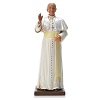
Here you will find a selection of different articles: Pope Francis’ Good Shepherd’s Cross, rosary beads, pictures and much more.
Can divorced people get married in church?
The answer is no. Divorce determines the “termination of the civil effects of marriage”, but the religious bond is not broken, and therefore the divorced cannot remarry in church. Unless, of course, religious marriage has not been declared null and void by the Ecclesiastical Tribunal.
The parable of the Good Samaritan teaches us that love and compassion know no differences or prejudices, and that the...
18 March 2026
What’s the Future of Religion?
What’s the Future of Religion?
A Beginner’s Guide to Christianity
A Beginner’s Guide to Christianity
Mind-Blowing Statistics About Christianity You Need to Know
Mind-Blowing Statistics About Christianity You Need to Know
8714
Enter the Holyart world: $20 discount voucher valid on over 60,000 items
Come and discover Holyart, the largest e-commerce of religious articles in Europe and immediately receive a $20 voucher to use with your first purchase.
Check your mailbox: you will receive your discount within 5 minutes