Homepage | Religion | Miracles: what they are and how they are classified
Miracles: what they are and how they are classified
15 October 2025
Reading Time: 6minutes
Healings and exorcisms, apparitions, mastery over nature, even the resurrection of the dead. Jesus and his miracles, a legacy of history and Faith that remains ever relevant.
For the Catholic Church, miracles exist. Indeed, the miracles attributed to Jesus and reported in the canonical Gospels are to be regarded as historical events. We have deliberately made the distinction between the Canonical Gospels and the Apocryphal Gospels, because although in the latter miracles are even more numerous and spectacular, they are entirely devoid of historical veracity and therefore not recognised. After all, when speaking of the Apocryphal Gospels, it is common to encounter a more fairy-tale and marvellous dimension to the events in the life of Jesus and those who knew him, and it is inevitable that the miracles also become true acts of magic, wonders told more to amaze and capture attention than to inspire genuine Faith.
Read more:
The lost years of Jesus’ life
Let us investigate the lost years of Jesus’ life. What was he doing before he started preaching? Did he ever…
The miracles recognised by the Church are therefore historical accounts, even if interpreted from a theological point of view, or allegorical according to some biblical scholars, but in any case clear signs of the identity of Jesus and of his mission. The Catechism (Catechism of the Catholic Church, nos. 547–550) describes them as testimony to the fact that he is the Son of God, as an invitation to believe in him, and acknowledges their effectiveness in strengthening Faith. In particular, Eucharistic Miracles are those supernatural events through which God confirms the real presence of the body and blood of Christ in the Eucharist, thereby affirming the Faith of believers.
More generally, a miracle is any occurrence not attributable to natural causes but justified by divine intervention. It is, in fact, solely within God’s will and power to alter the natural order of things, since he created and established it. Thus the overturning of the laws of nature is his prerogative. For this reason, it becomes essential for the Church to recognise and regulate what truly constitutes a miracle, which miracles are to be considered genuine, and which false, driven by the will to deceive or by mere suggestion.
In the New Testament, miracles are the exclusive domain of Jesus. It is he who performs them, by virtue of his divine nature, without needing to call upon the Father. Yet he has the will and the capacity to bestow upon the disciples the power to perform miracles. The miracles of Jesus are always driven by the desire to do good—sometimes to inspire Faith, sometimes to strengthen it—never useless, never performed merely to amaze or astonish, and least of all to convince sceptics.
The miracles performed by Jesus may be divided into:
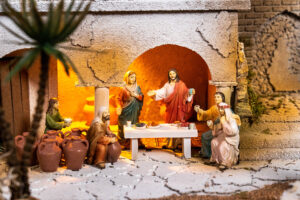
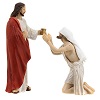
The religious figurine depicts a scene of the life of Jesus Christ in which he heals a blind man…
Miracles over nature are those in which Jesus demonstrates his ability to command the forces of nature and subvert its rules. Consider the calming of the storm on the lake (Matthew 8:23–27; Mark 4:35–41; Luke 8:22–25), the multiplication of the loaves and fishes (Matthew 14:13–21), and the transformation of water into wine (John 2:1–11).
Healing miracles represent the majority of those attributed to Jesus, probably because it has always been natural for those suffering from illness or disability to seek a miracle. Jesus healed people of physical ailments, but also of mental afflictions and demonic possession, by laying on hands, pronouncing specific words, or using saliva, mud, and so forth. Among the examples are the healing of the woman with haemorrhages (Matthew 9:20–22), the deaf-mute who spoke again (Mark 7:31–37), and the blind man of Jericho who regained his sight (Mark 8:22–26). Jesus also gave the Twelve Apostles the power to cast out demons and heal diseases and infirmities (Matthew 10:1). Regarding exorcisms, one may recall the man in the country of the Gerasenes possessed by many demons, who told Jesus his name was Legion (Luke 8:26–39). Finally, in the canonical Gospels there are three cases of resurrection: the daughter of Jairus (Mark 5:21–43), the son of the widow at Nain (Luke 7:11–17), and the most famous, the resurrection of Lazarus (John 11:1–44).
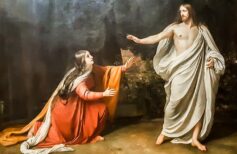
Among the epiphanies and apparitions we may recall those of Jesus after the Resurrection and the one that struck Paul of Tarsus on the road to Damascus.
Miracles in the Old Testament, together with prophecies, are proof of the existence of God and of his plan. The wondrous events of the Old Testament are never performed by men themselves, but by God through men chosen by him for a specific purpose, whether prophets or wonder-workers. They are never useless acts of magic or displays of power for their own sake, but signs of divine benevolence or wrath, testimonies of God’s might.
One of the most frequent terms in the Old Testament to define a miracle is σημείον, sēmeíon, “sign”. But this definition is too broad, also referring to natural events not necessarily linked to God. The Greek term τέρας, téras, “wonder”, is often used with a negative connotation, as a punishment inflicted by God upon men.
To summarise, here are the four Greek terms used in the Holy Scriptures to indicate miracles:
Sēmeion, “sign”, clear indication of divine intervention or presence
Taumata, “miracles”, marvels, events that inspire astonishment
Dynameis, “powers”, works attributed to a superhuman or supernatural force
Erga, “works”, actions of Jesus, his disciples or the saints
Among the most famous examples of miracles in the Old Testament we may recall the Great Flood (Genesis 6–9), probably derived from a similar episode in the Sumerian Epic of Gilgamesh, itself inspired by a possible flooding of the Black Sea around 5600 BC, and the Exodus of the Hebrews from Egypt, which recounts many miracles, from the Plagues of Egypt to manna from heaven, culminating in the famous parting of the Red Sea.
More generally, in the Old Testament miracles are never wonders for their own sake or futile acts of magic, but prodigious events willed by God as demonstrations of his Power, or of the authority granted to those acting in his name at that moment (such as Moses).
The first miracle of Jesus
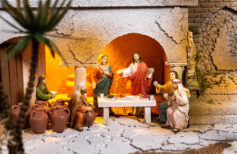
The first miracle attributed to Jesus, at the beginning of his mission, is that of the Wedding at Cana, recounted by the evangelist John (John 2:1–12). It is the famous transformation of water into wine, performed by Jesus while attending a wedding in Cana of Galilee with some disciples and his mother Mary. Since the wine had run out and the guests had nothing to drink, Mary asked her Son to do something, and Jesus had six jars filled with water and turned it into wine.
In addition to representing the institution of the Sacrament of Marriage by Jesus, the Wedding at Cana is the first of the so-called Seven Signs, the seven miracles which in John’s Gospel narrate the path taken by Jesus to reveal to his disciples his Powers and his destiny, before reaching the Last Supper, the Passion and death. In effect, this miracle, encouraged by the Virgin Mary, represents the official beginning of his mission, which would end only with the Passion and death.
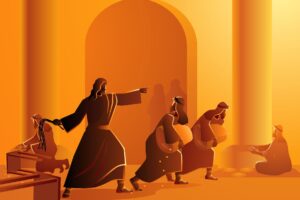
The expulsion of the merchants from the Temple of Jerusalem represents an act of rebellion by Jesus against a now...
25 February 2026
What’s the Future of Religion?
What’s the Future of Religion?
A Beginner’s Guide to Christianity
A Beginner’s Guide to Christianity
Mind-Blowing Statistics About Christianity You Need to Know
Mind-Blowing Statistics About Christianity You Need to Know
7973
Enter the Holyart world: $20 discount voucher valid on over 60,000 items
Come and discover Holyart, the largest e-commerce of religious articles in Europe and immediately receive a $20 voucher to use with your first purchase.
Check your mailbox: you will receive your discount within 5 minutes



 Buy Now:The religious figurine depicts a scene of the life of Jesus Christ in which he heals a blind man…