The death of a Pope is never a common event. It never has been, in the two thousand years of the Church’s history.
When a Pontiff dies, it’s not just the end of a man—it marks the close of an entire spiritual, pastoral, political, and human era. A voice that has guided millions of faithful, that has prayed, spoken, suffered, and forgiven, falls silent. One door closes, but another opens—a suspended, sacred, and solemn time known as the Sede Vacante (“Vacant See”). The bells toll not only in mourning; they also ring to remind the world that the Church is now orphaned. But it is not lost. Every gesture, every step, every word is already written in a millennia-old liturgy that guides the transition from one pontificate to the next. Everything has its order, its timing, its meaning. Even silence.
Time stands still for a moment, but the millennial engine of the Church does not stop. It sets into motion a sequence of ancient gestures, solemn symbols, and crucial decisions.
Behind the Vatican walls, a ritual machine begins to move—full of secrets and symbols, intertwining spirituality with history, grief with responsibility. From the first moment the Pope’s death is confirmed until the announcement of the new pontiff with the famous Habemus Papam, the Church embarks on a journey that blends the human and the divine, mourning and hope.
But what exactly happens between the death of a Pope and the election of his successor? Who holds power? Who guards the silence? And who decides when it’s time to turn the page?
Here are all the phases, step by step—each marked by a ritual that combines faith, mourning, and responsibility.
The Role of the Camerlengo
In the heart of the Vatican, the moment the Pope closes his eyes to the world, one man approaches his bedside: the Camerlengo, custodian of the transition between one pontificate and the next.
An ancient title that sounds like it came from a medieval novel, yet it still carries one of the most delicate and symbolic responsibilities in the Catholic Church.
The Camerlengo—currently Cardinal Kevin Joseph Farrell—is the guardian of the “in-between time”, when the Church is without a leader, but not without order.
His duty begins with a gesture full of meaning: officially certifying the Pope’s death. In the past, this was done by calling the Pope’s name three times and solemnly declaring in Latin “Vere Papa mortuus est.” Today, confirmation is entrusted to a physician, but the solemnity remains unchanged.
Once the death is confirmed, the Camerlengo symbolically enters the sphere of power. He seals the papal apartments, halts all official Vatican communications, and assumes control of the vacant Apostolic See. But his authority is most visibly expressed through one specific object: the Fisherman’s Ring(Anulus Piscatoris), the Pope’s personal seal, worn on the ring finger of his right hand. It bears the Pope’s name and an image of Saint Peter fishing—symbol of his mission as a “fisher of men.”
Upon the Pope’s death, the ring must be destroyed or rendered unusable. The Camerlengo, in the presence of cardinals, carries out this ritual—either by breaking it or engraving two crossed lines upon it—ensuring no one can forge documents or claim authority in the late pontiff’s name.
A simple yet powerful act. It says: “This pontificate is over. No one can speak in his name anymore.”
But what breaks is not just an object. It is the tangible end of an era—etched in metal. A closure that opens the way for a new beginning. From that moment, the world knows the Church is preparing to turn the page, while the Camerlengo, silent and watchful, guards the waiting.
Following the Pope’s death and the Camerlengo’s formal assumption of his role, he is not left alone. Through the wisdom of centuries, the Church has ensured that every stage is monitored by multiple eyes, hearts, and consciences.
Thus, among the cardinals already gathered in the Vatican for the upcoming Conclave, three assistants are chosen by lot: one bishop, one priest, and one deacon—one for each ecclesiastical order. Together with the Camerlengo, they form the so-called Particular Congregation, a small committee tasked with helping him in day-to-day decisions and overseeing the Church’s routine administration during the Sede Vacante. This ensures balance and transparency during the time when the Chair of Peter is empty and the entire Church is waiting.
When a Pope dies, it is not only the Church’s voice that speaks—its gestures and ritual silences also speak volumes. One of the most eloquent moments unfolds before millions of eyes, yet in a deeply intimate atmosphere.
In the heart of St. Peter’s Square, the large bronze door leading to the Vatican Curia offices is half-closed. One side open, the other shut. Not a mistake—but a sign. The Church is alive, but wounded. Moving forward, but without its shepherd.
Simultaneously, the bells of the Basilica toll mournfully—a solemn, heavy rhythm, not the joyful peals of celebration. The sound spreads through Rome, and then the world. Whoever hears it understands: the Pope is dead.
This simple but powerful gesture marks the visible beginning of the Sede Vacante. From that moment, everything changes—but everything already follows an order. Church time becomes memory, prayer, and waiting.
Thus begins the time of mourning. But the Church is never empty—it is expectant.
The Pope’s body is prepared, dressed in sacred vestments—a white miter, a red chasuble—and placed in a wooden and zinc coffin, with his face visible, so the faithful can pay their final respects. Traditionally, the body was exposed without a coffin, but Pope Francis opted for a simpler ritual: dignity without grandeur. Less pomp, more essence. He revised the liturgical texts, shortened the ceremonies, and restored to the Pope’s death a more human and spiritual dimension.
The mourning lasts nine days—the Novendiales—during which cardinals celebrate daily Masses in suffrage. There are three solemn milestones in this period: the confirmation of death, public viewing, and burial. The latter typically takes place in the Vatican Grottoes, beneath St. Peter’s Basilica, beside the pontiff’s predecessors—where the silent soil holds the history of the Church.
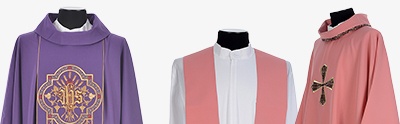
Chasuble 100% polyester golden embellishments. Available in four liturgical colours…
Francis’ Exception: Choosing Santa Maria Maggiore
Pope Francis did not wish to rest among the solemn marble tombs of the Vatican Grottoes.
He chose the earth.
He chose simplicity.
And, as he so often did during his pontificate, he broke with tradition in a gesture of powerful coherence.
In his 2022 testament, Jorge Mario Bergoglio laid out his wishes clearly: no monuments, no grand inscriptions. Just a simple burial niche in the Basilica of Santa Maria Maggiore, with a single word engraved: Franciscus. Nothing more. A tomb in the earth, without embellishment. A final message more powerful than a thousand homilies.
But this was not just a stylistic choice—it was profoundly spiritual.
Santa Maria Maggiore is the Marian heart of Rome, the home of the Salus Populi Romani—the icon to which Francis entrusted every step of his pontificate. He visited it in silence before and after every apostolic journey—without announcements or fanfare. It was his sacred place.
It also connects to his Jesuit roots: it was in this very basilica that Saint Ignatius of Loyola, founder of the Society of Jesus, celebrated his first Mass in 1538 after receiving papal approval. Francis, the first Jesuit Pope in history, chose to return there.
And then there is his trademark sobriety. Even in death, Francis wished to strip away power and remain a man among men. His tomb is that of a shepherd. No statues, no golden crypt—just earth.
This decision also had practical consequences for the funeral protocol.
Francis requested that his body be placed directly in the coffin inside the Sistine Chapel, without the traditional raised catafalque, and that a simplified liturgy with revised texts be used—to restore the centrality of silence and prayer.
The burial expenses were not covered by the Vatican, but by an anonymous benefactor, as Francis himself had requested. One final act of humility that speaks to the hearts of the humble.
Resin statue of Pope Francis 7.9 inches. Small statue of 7.9x2x2 inches, representing Pope Francis…
The Conclave and the Election of the New Pope
Meanwhile, behind closed doors, the cardinals prepare to choose Peter’s successor. The Conclave begins between the 15th and 20th day after the death, barring exceptions.
It is held in the Sistine Chapel, a place infused with art and the Holy Spirit, where only the cardinal electors may enter. They vote in secret ballots. Each vote is burned in a stove with added chemicals.
A black smoke rising signals to the world that no decision has yet been reached. But when white smoke billows from the chimney, it is as if heaven itself responds: a new Pope has been chosen.
The name of the newly elected is announced to the waiting crowd with the historic formula: “Annuntio vobis gaudium magnum: Habemus Papam.”
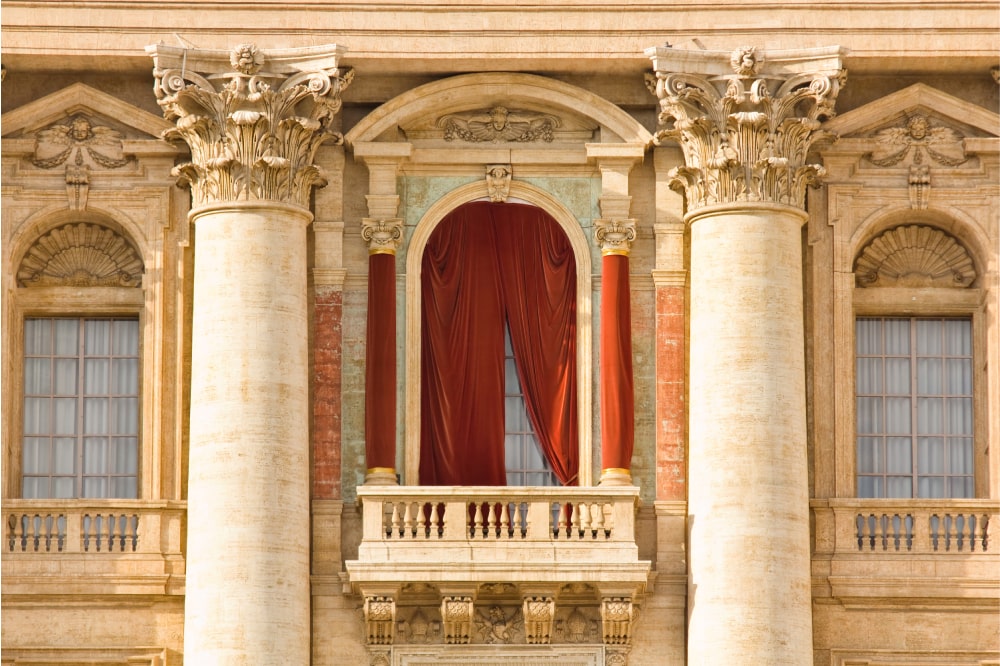
It is the moment when a man, dressed in white, steps out onto the balcony of St. Peter’s Basilica—and the entire world holds its breath. A new pontificate begins. And with it, a new chapter in the history of the Church.
Sacred icons: genuine expressions of religiosity, symbolic works that transcend art. How are they painted? Discovering egg tempera Much of...
2 March 2026
What’s the Future of Religion?
What’s the Future of Religion?
A Beginner’s Guide to Christianity
A Beginner’s Guide to Christianity
Mind-Blowing Statistics About Christianity You Need to Know
Mind-Blowing Statistics About Christianity You Need to Know
7218
Enter the Holyart world: $20 discount voucher valid on over 60,000 items
Come and discover Holyart, the largest e-commerce of religious articles in Europe and immediately receive a $20 voucher to use with your first purchase.
Check your mailbox: you will receive your discount within 5 minutes