Saint Christopher is remembered as the protector of pilgrims. History and legend intertwine to create a cult that has existed for centuries in both the East and the West
On 25 July, the Western Catholic Church commemorates Saint Christopher, patron of pilgrims, military drivers, travellers in general, as well as sportspeople, greengrocers, and gardeners. The multifaceted nature of this Saint is closely tied to his history, and especially to the many legends that arose around him during the Middle Ages. Saint Christopher is one of the most venerated saints in Christian tradition, widely recognised as the protector of pilgrims. His story has ancient roots and merges with legends and popular traditions. His conversion—a recurring theme in various versions of his story—places him among the so-called “pilgrim saints”: those who found their faith through a journey, sometimes purely internal.
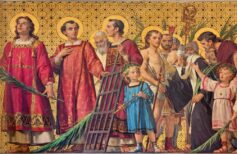
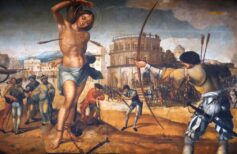
According to Eastern hagiography, Christopher was a fearsome-looking giant who served in the imperial army. After converting to Christianity, he openly professed his faith to his fellow soldiers, who imprisoned, tortured, and eventually beheaded him.
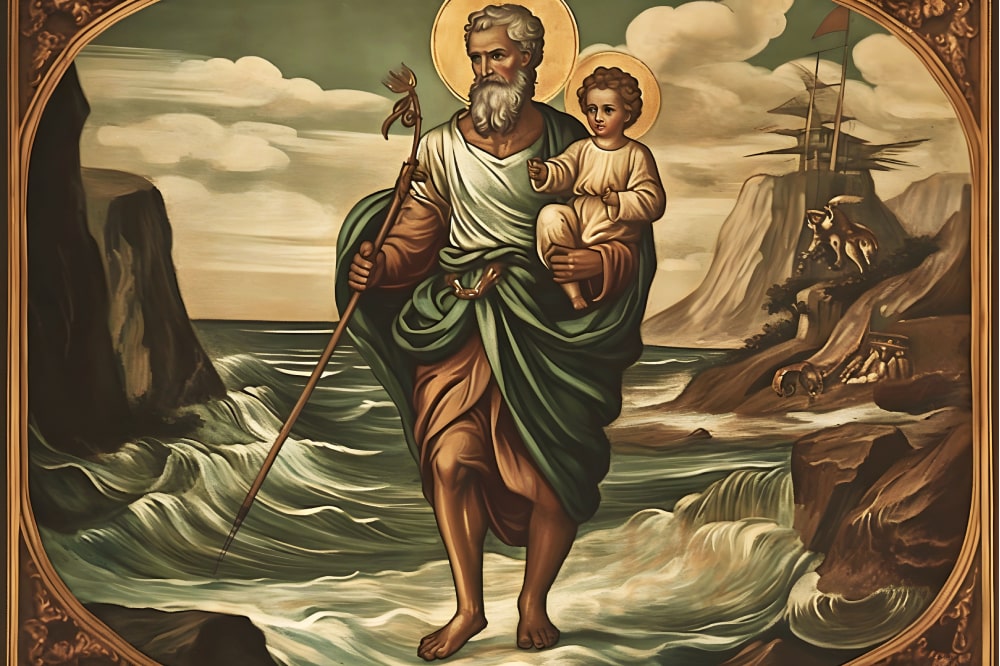
In the West, particularly in the Legenda Aurea by Jacobus de Voragine, legends arose linked to his name—Christopher—which in Greek means “Christ-bearer”. According to this account, Saint Christopher was originally a Canaanite ferryman named Reprobus, a solitary and gruff giant who lived in a forest and helped people cross a river in Lycia. One night, a child approached him, asking to be carried across. Despite his immense size, Reprobus struggled greatly to carry the boy, who grew heavier with each step. Battling the river’s strong current, the giant reached the other shore, utterly exhausted. It was then that the child revealed his true identity: he was Christ. He told Reprobus that he had not only borne the weight of his small body, but the weight of the entire world. Moved deeply by this experience, Reprobus was baptised and took the name Christopher, symbolising his new mission of bearing Christ to others. From that moment, he dedicated his life to evangelisation, converting those around him. For this reason, sacred iconography often depicts Saint Christopher as a large man carrying the Christ Child on his shoulders.
Clearly, the Western interpretation of Saint Christopher’s legend emphasises the importance of carrying Christ in one’s life and sharing faith with others. The story also highlights the themes of sacrifice and accepting the responsibilities entrusted to us. Saint Christopher becomes a model of devotion, strength, and commitment to the cause of Christ—an example for all the faithful. His role as a ferryman takes on symbolic meaning, representing his choice to lead others to true faith.
The Martyrdomand Transportation of Saint Christopher was depicted by Andrea Mantegna in a detached fresco from the Ovetari Chapel in the Church of the Eremitani in Padua, showing the giant’s body bound and surrounded by executioners. According to legend, after his death his body was transported and buried in an unknown location. Over the centuries, many legends arose about the transportation of his relics. Some traditions claim his body was carried by a wild river, while others tell of a statue that miraculously moved itself.
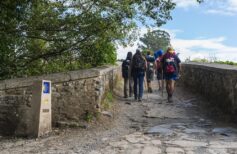
Among the many pilgrim routes, the Way of Saint Christopher is a unique path that invites travellers to discover not only external landscapes but also the landscapes within themselves. Through churches, relics, and masterpieces of art and architecture, this journey offers an unforgettable experience. It can be taken alone or in company, on foot, with a dog, on horseback, with a donkey, or by bicycle. Spanning 450 kilometres across the provinces of Pordenone, the Tagliamento, and the Piave rivers, it showcases unspoilt landscapes and functions as a true open-air museum. The Way of Saint Christopher offers the opportunity to immerse oneself in nature, explore places of worship, and admire the art and architecture that line the path. Each stage delivers unique and spectacular moments, enriching the journey with enchanting scenery and magical inspiration.
As with many pilgrimage destinations, embarking on the Way of Saint Christopher represents a chance to rediscover oneself, overcome personal limits, and explore new and evocative places. Divided into six main stages, the route can be followed at one’s own pace, respecting individual rhythms, interests, and curiosities, with optional sub-stages and detours.
Stop One, from Stevenà to Aviano, includes Palù del Livenza, the San Floriano Rural Nature Park, the Sanctuary Church of the Madonna del Persego, Caneva Castle, and Polcenigo Castle. In Aviano, the Cathedral of Saint Zenone is well worth a visit.
Stop Two, from Aviano to Maniago, offers breathtaking views and passes the Marian Sanctuary of the Madonna del Monte, Montereale Valcellina, and the “city of knives” itself—
Stop Three, from Maniago to Meduno, explores Val Colvera and the medieval village of Poffabro—one of Italy’s most beautiful. It continues to the Sanctuary of the Madonna della Stangada and on to Meduno.
Stop Four, from Meduno to Clauzetto, takes in Toppo with its medieval castle, Travesio with its frescoes and sculptures, and Castelnovo del Friuli with another castle and the Church of Saint Nicholas. Clauzetto, known as the “balcony of Friuli”, boasts a splendid panoramic view and houses the Relic of Christ’s Blood.
Stop Five, from Clauzetto to Spilimbergo, goes via the ancient parish of San Martino d’Asio, the sulphurous springs of Vito d’Asio and Anduins, Pinzano Castle, and finally Spilimbergo, the city of mosaics.
Final Stop, from Spilimbergo back to Maniago, leads pilgrims through farmland and woods, passing through Lestans, Sequals, Cavasso Nuovo, and Fanna, featuring eight notable churches, charming villages, and beautiful Venetian villas along the way.
San Zeno wall crucifix 12.5 cm. Wall cross made of bronze…
The Medal of Saint Christopher
One of the most recognised and beloved symbols associated with Saint Christopher is the medal that bears his name. The Saint Christopher medal is an icon of protection and faith for travellers. Usually made of metal, it depicts the saint in iconographic form, carrying the Christ Child on his shoulders across a river. This image recalls the legend of Saint Christopher the ferryman, symbolising his dedication to bearing Christ in his life and his willingness to carry the weight of the world.
The medal is considered a talisman for pilgrims, worn as a sign of trust in the Saint’s protection during their journeys. It symbolises the strength, courage, and faith in God needed to face life’s challenges. The Saint Christopher medal is also a symbol of devotion for travellers. The tradition of wearing one dates back as far as the fifth century and has become common among Catholic faithful as a tangible expression of prayer for protection and blessing during travel. Many even attach the medal to their car in the form of a clipor keychain.
The healing of the paralytic in Capernaum is one of the many miracles of Jesus, but it contains a series...
16 March 2026
What’s the Future of Religion?
What’s the Future of Religion?
A Beginner’s Guide to Christianity
A Beginner’s Guide to Christianity
Mind-Blowing Statistics About Christianity You Need to Know
Mind-Blowing Statistics About Christianity You Need to Know
7345
Enter the Holyart world: $20 discount voucher valid on over 60,000 items
Come and discover Holyart, the largest e-commerce of religious articles in Europe and immediately receive a $20 voucher to use with your first purchase.
Check your mailbox: you will receive your discount within 5 minutes