We are used to hearing Jesus referred to as the Good Shepherd. From childhood, we have seen holy cards and images depicting Him with sheep and lambs. But where does this imagery come from?
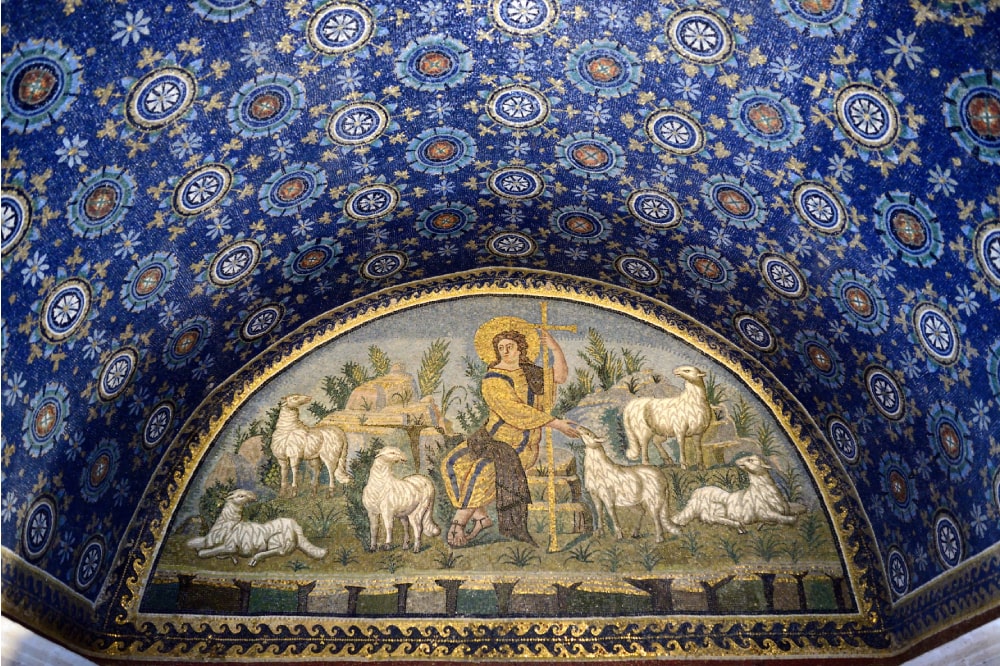
Among the symbolic representations of Jesus, that of the Good Shepherd was perhaps the most widespread as early as the first centuries of Christianity, when Christians had to take refuge in the catacombs to practise their faith. It is here that we find the earliest depictions of a young man carrying a lamb on his shoulders—a representation that derives from a pagan image: that of Hermes Kriophoros, who carries the ram to be sacrificed.
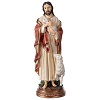
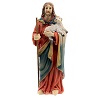
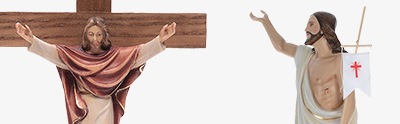
This statue is made of resin, a delicate material that, compared to PVC, allows for excellent lines and details.
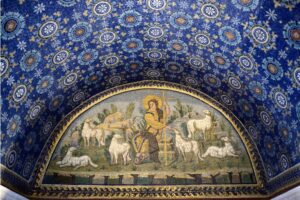
Although this image continued to be used in later centuries, after Christianity was proclaimed the official religion, it was only around the 5th century that it took on its conventional form. Jesus is depicted in the iconographic style of the time, with sumptuous garments, a halo around His head, and a sheep upon His shoulders.
It is the Gospel of John that describes Jesus as the Good Shepherd who sacrifices Himself for His sheep. In fact, it is Jesus Himself who uses this title: “7 Therefore Jesus said again, ‘Very truly I tell you, I am the gate for the sheep. 8 All who have come before me are thieves and robbers, but the sheep have not listened to them. 9 I am the gate; whoever enters through me will be saved. They will come in and go out, and find pasture. 10 The thief comes only to steal and kill and destroy; I have come that they may have life, and have it to the full. 11 I am the good shepherd. The good shepherd lays down his life for the sheep. 12 The hired hand is not the shepherd and does not own the sheep. So when he sees the wolf coming, he abandons the sheep and runs away. Then the wolf attacks the flock and scatters it. 13 The man runs away because he is a hired hand and cares nothing for the sheep. 14 I am the good shepherd; I know my sheep and my sheep know me— 15 just as the Father knows me and I know the Father—and I lay down my life for the sheep. 16 I have other sheep that are not of this sheepfold. I must bring them also. They too will listen to my voice, and there shall be one flock and one shepherd. 17 The reason my Father loves me is that I lay down my life—only to take it up again. 18 No one takes it from me, but I lay it down of my own accord. I have authority to lay it down and authority to take it up again. This command I received from my Father.’” (John 10:7–18)
This statue is hand made and hand painted by the nuns of the Atelier d’Art de Bethléem
The pericope or parable of the Good Shepherd is not the only passage in the Gospels where the image of the shepherd and the sheep is used. We may think of the Parable of the Lost Sheep, one of the three parables of mercy. It tells of a shepherd who, upon noticing one sheep missing, leaves the whole flock to go and search for it. We read it in both Matthew and Luke’s Gospels, and its meaning is simple: just as the good shepherd is not concerned solely with the whole flock, but braves all dangers to recover the one lost sheep, so God will always care more deeply for the one who, having lost their way and fallen into the darkness of sin, rediscovers faith and the path of love, rather than the one who has never wavered.
Even Ezekiel had spoken of God as a shepherd who seeks out His sheep to care for them, gathering them from all parts and leading them to graze in fertile, peaceful places, searching for and tending to those who have gone astray: “11 For this is what the Sovereign Lord says: I myself will search for my sheep and look after them. 12 As a shepherd looks after his scattered flock when he is with them, so will I look after my sheep. I will rescue them from all the places where they were scattered on a day of clouds and darkness. 13 I will bring them out from the nations and gather them from the countries, and I will bring them into their own land. I will pasture them on the mountains of Israel, in the ravines and in all the settlements in the land. 14 I will tend them in a good pasture, and the mountain heights of Israel will be their grazing land. There they will lie down in good grazing land, and there they will feed in a rich pasture on the mountains of Israel. 15 I myself will tend my sheep and have them lie down, declares the Sovereign Lord. 16 I will search for the lost and bring back the strays. I will bind up the injured and strengthen the weak, but the sleek and the strong I will destroy. I will shepherd the flock with justice.” (Ezekiel 34:11–16)
Let us also think of Psalm 23, the Psalm of David: The Lord is my shepherd; I lack nothing. He makes me lie down in green pastures, He leads me beside quiet waters, He refreshes my soul. He guides me along the right paths for His name’s sake. Even though I walk through the darkest valley, I will fear no evil, for You are with me; Your rod and Your staff, they comfort me.
Why Does Jesus Compare Himself to the Good Shepherd?
Reading the parable of the Good Shepherd in the Gospel of John, it is not difficult to understand that in it Jesus is revealing the future—His own sacrifice. Just as the shepherd is ready to lay down his life for his sheep, so Jesus gives His life for humankind, sacrificing Himself and surrendering to terrible suffering.
But there’s more. He declares His love not only for the sheep of His own flock, but also for those who live outside the sheepfold. In this, we see His desire to gather around Himself not only the devoted, but also those who do not yet believe in Him.
In the parable of the lost sheep, Jesus’ message of love resounds powerfully. He is ready to forgive sinners—indeed, to love them even more because they are fragile and vulnerable to sin. It is to them that He devotes the greatest care, to find them again, to welcome them, and to heal them in body and soul, just as a shepherd devotes more attention to the sheep that are sick or injured.
Jesus presents Himself as the Good Shepherd, ready to sacrifice everything for His sheep, to live in solitude among the pastures solely to feed them properly and keep them safe. He declares Himself their guardian—even the gate of the sheep, the doorway through which one must pass to attain salvation and forgiveness.
The nourishment He offers is His own Flesh, His own Blood, in the continual renewal of the Eucharistic sacrifice, and so He not only leads us to pasture, but becomes pasture Himself—food for the soul, sustenance for the spirit, water for our unquenchable thirst.
His death on the Cross is just the beginning of hope, the beginning of salvation for His flock, guarded by His generous love and inspired by that same love to do likewise: to dedicate ourselves to others, especially the weakest, to those who are lost, even to the point of ultimate sacrifice, that we might all walk together along the path traced by Jesus toward the Kingdom of Heaven.
Prayer to Jesus the Good Shepherd
There are many prayers dedicated to Christ the Good Shepherd. Here is a prayer by Saint John Paul II to Jesus the Good Shepherd, asking for vocations among the young:
Lord Jesus Christ, Good Shepherd of our souls, You who know Your sheep and know how to reach the human heart, open the minds and hearts of those young people who seek and await a word of truth for their lives; help them to feel that only in the mystery of Your incarnation can they find full light today; awaken the courage in those who know where to seek truth but fear that Your call may be too demanding; stir the hearts of those who wish to follow You but cannot overcome uncertainty and fear, and end up listening to other voices and following other, aimless paths. You who are the Word of the Father, Word that creates and saves, Word that enlightens and strengthens hearts, with Your Spirit overcome resistance and hesitation in indecisive souls; awaken in those You call the courage to respond in love: Here I am, send me. Virgin Mary, young daughter of Israel, support with your maternal love those young people to whom the Father makes His voice heard, and sustain those who are already consecrated. May they repeat to You the yes of a joyful and irrevocable gift. Amen.
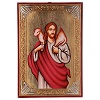
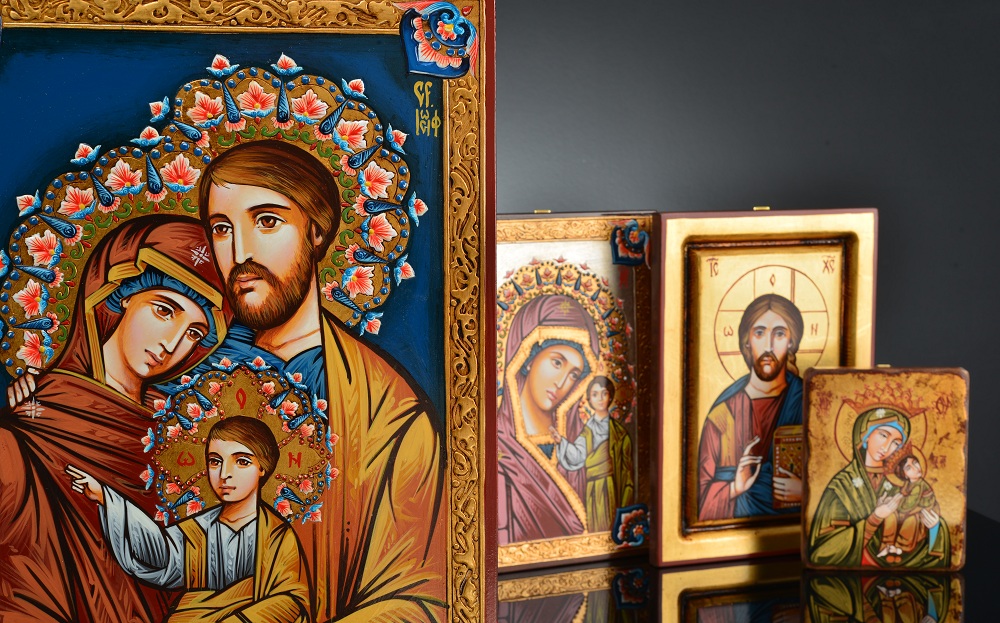
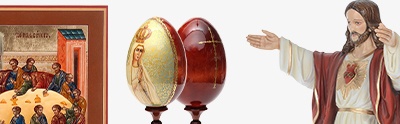
Hand-painted Rumenian icon represeting Jesus, the Good Sheperd who il looking for lost sheep.
And here is a prayer to Jesus the Good Shepherd that each of us may recite when feeling lost and in need of being saved:
My Jesus, I too am one of Your little sheep; so many times I’ve wanted to stray from You, I’ve left behind the green pastures, the quiet waters where You led me, I’ve refused to follow You, to remain within Your flock. But I found only rocks and thorns, bitter waters and venomous snakes; in the solitude and the darkness I bleated with fear, I longed to see Your face, to hear Your voice…
And You too felt great sorrow for me, You called and searched for me, in ditches and among cliffs, at last You gathered me up, trembling, in Your arms, laid me to rest upon Your heart, You bandaged my bleeding foot. And now that we have found each other again, O my Lord, I want always to stay with You, close to You, never again to be separated—never again! I love You, Jesus, my Good Shepherd, my Lord and my God; may I always remain with You, always with You, in this world and for all eternity. Thank You, Lord Jesus, my Lord and my God, my everything, now and forever.
When Is Jesus the Good Shepherd Celebrated?
Jesus the Good Shepherd is celebrated on the fourth Sunday of Eastertide. The liturgy of this day is dedicated to prayer for vocations, to support and guide young people who wish to embrace the path of faith. On this day, we all focus on Jesus’ desire to see all His sheep gathered into one flock, united by faith and love.
It is a day for meditating on Jesus’ guidance, but also on the need to follow His example: to welcome into the flock even those who are not yet part of it, in a spirit of unity and harmony, and to forgive and even assist those who have gone astray.
Freedom of religion is a fundamental human right, defined by many national constitutions. That's why it's so important. What is...
23 February 2026
What’s the Future of Religion?
What’s the Future of Religion?
A Beginner’s Guide to Christianity
A Beginner’s Guide to Christianity
Mind-Blowing Statistics About Christianity You Need to Know
Mind-Blowing Statistics About Christianity You Need to Know
8828
Enter the Holyart world: $20 discount voucher valid on over 60,000 items
Come and discover Holyart, the largest e-commerce of religious articles in Europe and immediately receive a $20 voucher to use with your first purchase.
Check your mailbox: you will receive your discount within 5 minutes