The first curiosity that Palo Santo arouses in us comes from its name: Palo Santo, meaning “holy wood”. Of course, this is not the scientific name of this particular plant, which grows spontaneously in Central and South America, but is also cultivated precisely for its extraordinary properties. Its true name is Bursera graveolens, and it has always been used by South American peoples, who regard it as a kind of sacred tree. Europeans discovered it at the beginning of the 1800s, and the scholars who first catalogued it decided to give it this evocative nickname because Palo Santo blossoms on Christmas Day.
After centuries of indiscriminate exploitation, today Palo Santo is a protected plant. In fact, its aromatic-scented wood, which makes it so valuable, depends on many factors, ranging from the chemical composition of the soil, to the age of the tree, to the way the wood itself is harvested. For Palo Santo wood to reach its best fragrance, the tree from which it is taken must already be at least ten years old. Furthermore, the branches that are collected must have already fallen by themselves and must have dried naturally on the ground, where they are enriched by various fungi and lichens. Thus, in Palo Santo cultivation, one waits for the trees to die naturally, leaves them on the ground for 4–10 years, and then they are collected. At this point, new trees are planted, while the harvested wood is processed through a natural distillation method called steam distillation, which is used to treat substances that degrade at temperatures close to their boiling point. This makes the process particularly suitable for the production of essential oils and natural aromatic compounds. In practice, water or steam is introduced into the distillation column to lower the boiling point of the substances, and if this is not sufficient, the process is carried out under vacuum, until optimal conditions are achieved to separate the water from the active principles.
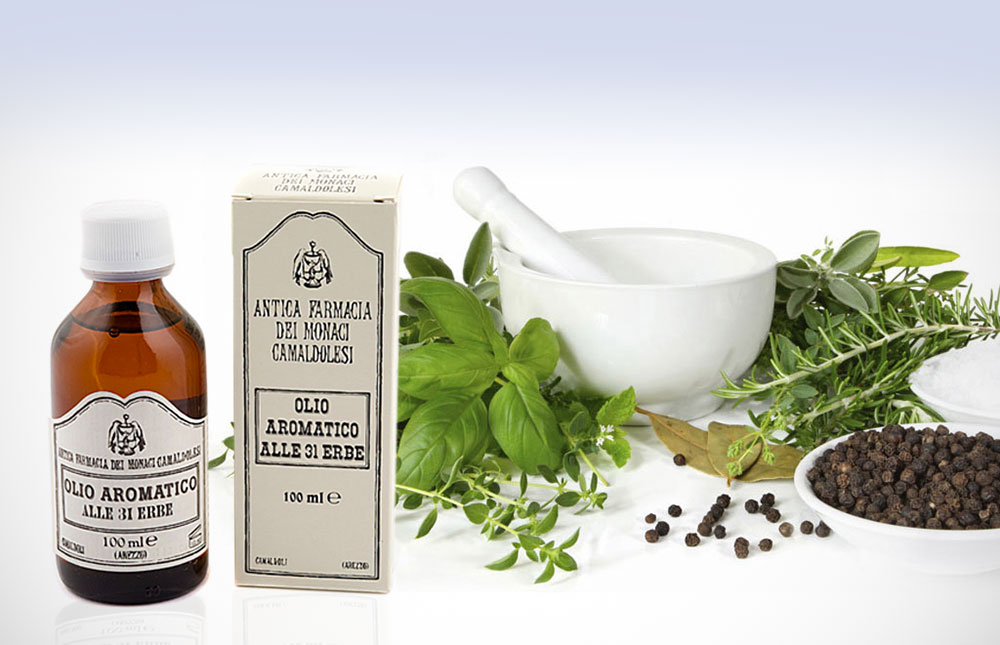
Essential oils produced with natural products in the Antica Farmacia di Camaldoli.
Let us discover how to use Palo Santo and how this special wood is employed in the production of natural incense.
The Properties of Palo Santo
We have said that in its countries of origin Palo Santo is considered a sacred, magical plant. It has been used for millennia to drive away negative energies, evil spirits, but also to prevent illnesses caused by these energies and spirits. In this case, we are talking about mental illnesses such as sadness, depression, low spirits, which according to local populations are often caused by mala energía or by the planga blanca, “an energy that cannot be seen, heard, touched, and has no smell”—a kind of evil eye, so to speak.
Burning Palo Santo is a way to purify domestic environments from these negative energies, but at the same time its aromatic smoke keeps mosquitoes and other insects away, whose bites are often the cause of real diseases, and even vampire bats. The Palo Santo that is burned for this type of use is also called Sahumerio, a Spanish word meaning incense, also used for other types of aromatic wood that are burned. Its fragrance makes it suitable for meditation, or simply for fighting bad odours in domestic spaces. Palo Santo shavings are also used for fumigation.
From the bark and resin of Palo Santo, Lynpha de Palo Santo is extracted, an essential oil with extraordinary soothing properties, used as a remedy for skin diseases. The resin is also used as a disinfectant and as a cure for tooth decay and toothache. Agüita is instead a herbal tea obtained from Palo Santo and used as a remedy for respiratory illnesses, urinary tract disorders, intestinal problems, but also as a cure for low spirits.
How to Burn Palo Santo
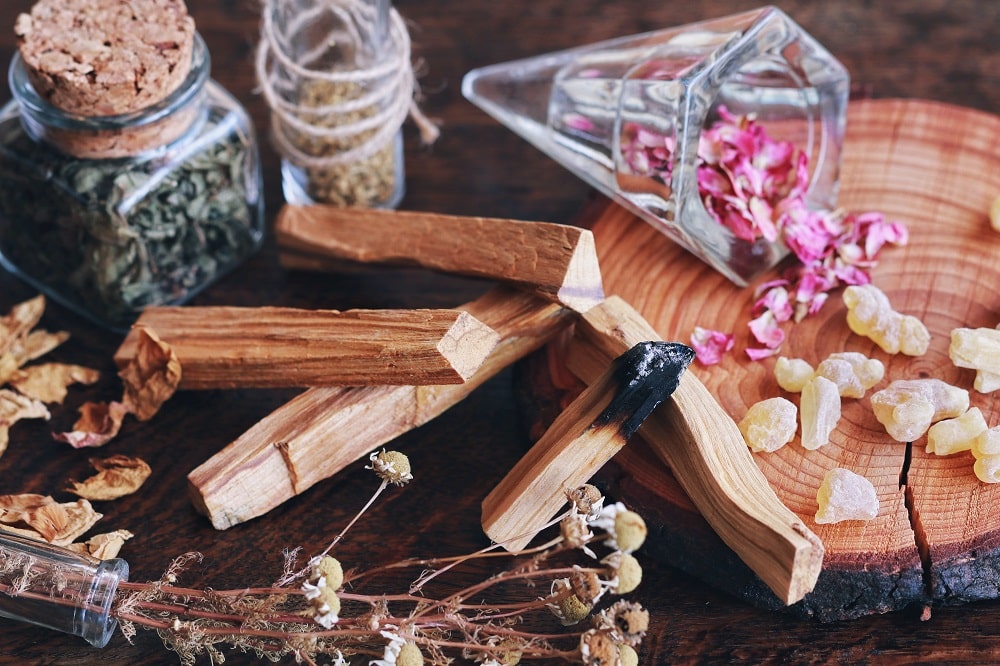
To burn Palo Santo while maintaining the qualities of the resin and essential oils it contains, and thus obtaining the best fragrance, a special method must be used. Palo Santo is sold in the form of small sticks, all more or less the same length and thickness. This too serves to ensure optimal preservation of the resins and essential oils during combustion.
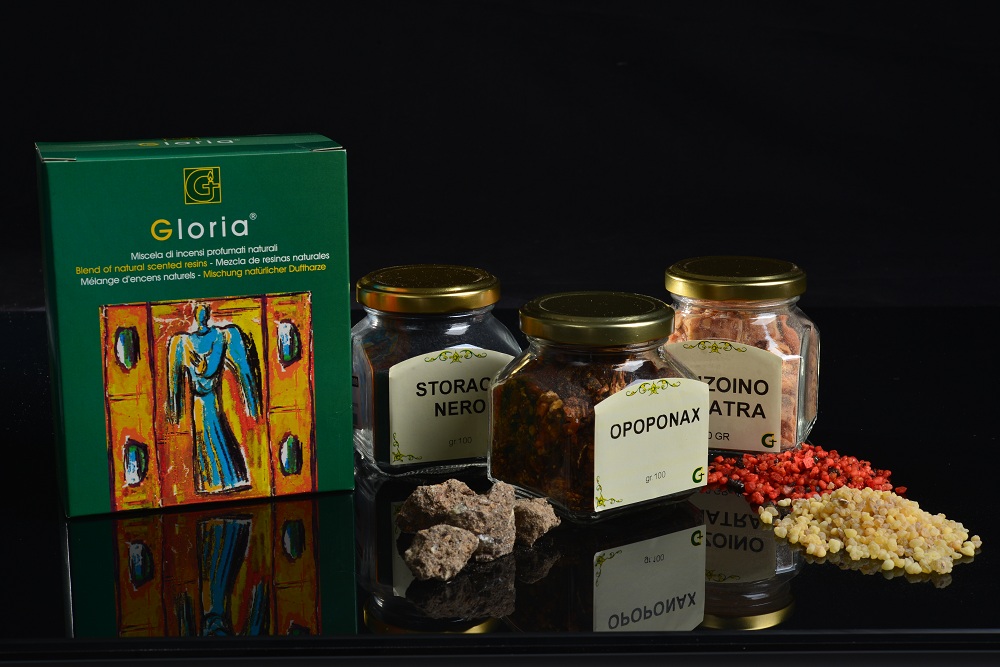
All the incenses are suitable both for a domestic and for a church use.
For the same reason, we must never expose the wood to a flame that is too intense, which would end up carbonising it: it should not be the flame that consumes Palo Santo wood, but the embers.
Light a lighter, bring it close to the wood and start burning it gently. Palo Santo wood will need about 30 seconds of contact with the flame to start burning evenly. Then extinguish the flame, blow on the wood, which will have started to release a characteristic white smoke. If the smoke is black, however, it means you are burning too many essential oils and spoiling the aromatic quality of Palo Santo.
If you feel that the wood is going out, blow on it again, but avoid using the flame once more, to prevent carbonising the Palo Santo. Use the wood to spread the smoke around the room and then let it extinguish naturally. The “holy stick” can be reused many times; just store it in a fireproof container.
Palo Santo Incense
In our online store you will find Palo Santo sticks to be burned as incense. There is the practical 30-gram pack of sticks collected by local populations at least four years after the natural fall of the tree and after the resin, enriched by fungi and mucilage from the soil, has covered and infused the sticks with the characteristic aroma, or the 40-gram pack, with slightly larger sticks.
Stick incense of Palo Santo from Bursera Graveolens, in approximatly 40 g package.
In both cases you will need to light the tip of the stick and, once it has caught, extinguish the flame. The glowing wood will release aromatic smoke for about two minutes. If you wish to keep the Palo Santo stick burning for longer, you can place it on a charcoal disc.
Since the origins of Christianity, there have been stories of saints in love that constitute examples of love, humanity, and...
4 February 2026
What’s the Future of Religion?
What’s the Future of Religion?
A Beginner’s Guide to Christianity
A Beginner’s Guide to Christianity
Mind-Blowing Statistics About Christianity You Need to Know
Mind-Blowing Statistics About Christianity You Need to Know
8463
Enter the Holyart world: $20 discount voucher valid on over 60,000 items
Come and discover Holyart, the largest e-commerce of religious articles in Europe and immediately receive a $20 voucher to use with your first purchase.
Check your mailbox: you will receive your discount within 5 minutes