Homepage | Religion | The meaning behind the parable of the Good Samaritan
The meaning behind the parable of the Good Samaritan
18 March 2026
Reading Time: 6minutes
The parable of the Good Samaritan teaches us that love and compassion know no differences or prejudices, and that the only way to please God is to love your neighbour
The parable of the Good Samaritan does not fall within the so-called parables of mercy, namely that of the lost sheep, that of the lost coinand that of the father and two sons. Yet, in many respects, it can be linked back to them. The fundamental difference is that, while the three parables quoted, told by the evangelist Luke, speak of divine Mercy and express God’s immense love for his children, the parable of the Good Samaritan is an invitation to universal love, mercy and charity that every man should demonstrate to his neighbor, to anyone in need of help, regardless of race, religion or social status.
Divine Mercy print on wood measuring 40×30 cm. This picture is made with a high quality print by craftsmen in Florence.
Jesus tells this parable in response to a scribe who asks him how to obtain eternal life. Jesus’ answer is not a magic formula, but an invitation to love one’s neighbour as oneself.
The story of the Good Samaritan is well known: a man at the end of his life, robbed and wounded, lies on the road. Two religious figures, a priest and a Levite, see him but pass by. A Samaritan, considered heretical and impure by the Jews, approaches and, with great compassion, takes care of him. He wraps him up, loads him onto his donkey, takes him to an inn, and pays for his care. He also promises to come back to make sure he’s okay. In a word, he takes care of him, of a stranger, moreover, a Jew who, as such, considers him an enemy, an idolater. To the scribe, Jesus, concluding the parable, recommends doing the same.
The scene portrays a wounded and exhausted Jew, lying on a donkey and carefully supported by the Good Samaritan, compassionately guiding him with altruistic gesture.
The parable of the Good Samaritan is a challenge for all of us. Jesus asks us to be like the Samaritan and to open our hearts to all who need us. It is an invitation to build a more compassionate and just world, where love wins over indifference and hatred.
Love knows no boundaries. We must love everyone, even our enemies and those who are different from us. Moreover, compassion must be more important than religious rules. The Samaritan is not concerned with defiling himself or breaking religious laws: he is concerned only with helping the wounded. Actions speak louder than words. It is not enough to say that we love our neighbour; we must prove it with our actions.
Printed icon of the Good Samaritan on wood 25×20 cm. Icon printed on wood and finished by Greek experienced craftsmen.
Who is our neighbour? And what do the different characters in the parable symbolise?
In the parable of the Good Samaritan, four figures embark on the journey from Jerusalem to Jericho, a scenario that symbolically represents the path of life. They come from different backgrounds and cultures, and embody different shades of the human soul. The assaulted man left agonising along the way, robbed and wounded, is a Jew, and symbolises the vulnerability and suffering that unite all human beings.
The priest and the Levite are both Jews and represent the religious figures of the time. Their indifference to the wounded highlights the coldness of a formal cult that does not translate into concrete actions of love and compassion.
The Samaritan, on the other hand, considered heretical and impure by the Jews, approaches man with deep compassion. His concrete acts of care and concern for the wounded subvert religious and social barriers, showing an authentic love that transcends divisions.
Tensions between Samaritans and Jews amplify the disruptive message of the parable. The Samaritan, despised and considered inferior, shows himself the true neighbour of the Jew in difficulty. Love and compassion reveal themselves as the universal principles that overcome all division and hatred.
The encounter on the road to Jericho becomes a metaphor for life itself. Sooner or later, we all find ourselves being like the victim: vulnerable and in need of help. Meeting a good Samaritan on our way can make a difference.
At the same time, each of us has the opportunity to become a good Samaritan for others, offering our help with love and without prejudice.
Read more:
Giving alms: is it charity?
Almsgiving to the poor is a manifestation of mercy strictly connected to the duties of a good Christian.
Who represents the Good Samaritan?
In the parable of the Good Samaritan, the Samaritan represents the one who demonstrates love and compassion for others, regardless of differences and reasons for friction. From a symbolic point of view, this character embodies universal love that goes beyond barriers and divisions.
He subverts expectations and demonstrates that genuine religiosity manifests as compassion and concrete help.
Some see in the Samaritan thefigure of Christ himself, who became close to suffering humanity. Others interpret it as a model of behaviour to follow in building a more just and compassionate world.
Regardless of interpretation, the Good Samaritan represents an ideal of love and altruism to which we can all aspire.
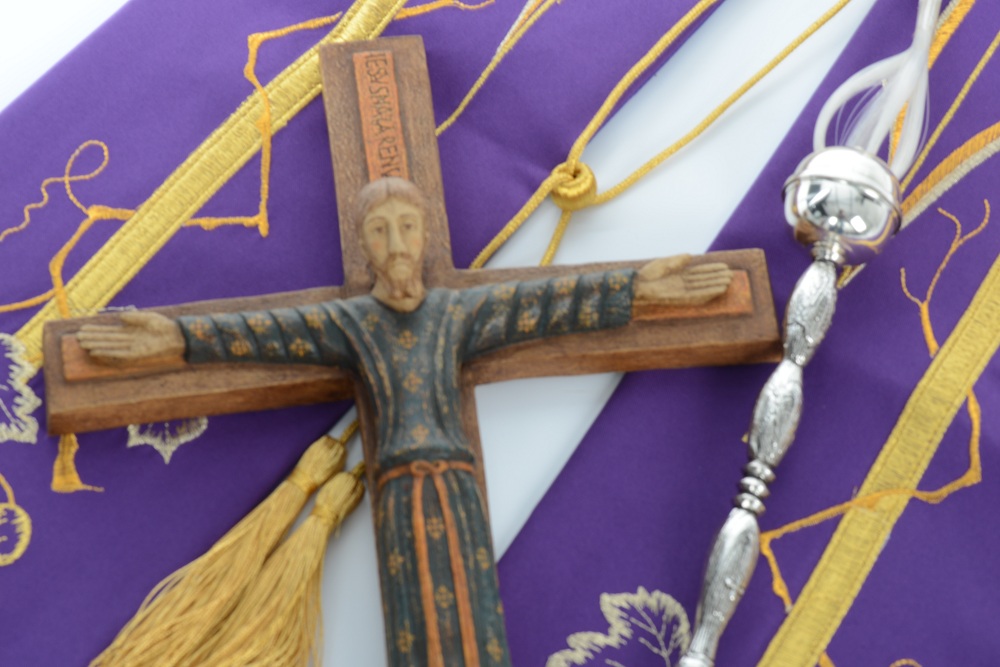
Natural wood crucifix inspired by Renaissance style, the cross is carved and the body of Christ features a light brown colour.
Who’s next in the parable of the Good Samaritan?
In the parable of the Good Samaritan, the “neighbour” is not uniquely defined. The parable itself invites the listener to reflect and give their own answer. The wounded Jew, the one who needs help and compassion, regardless of his identity or past actions, represents every person in need. The parable teaches us that our neighbour is anyone who needs our help, anyone we meet on our way. It is an invitation from Jesus to love everyone, without distinction. Love and compassion are the only criteria for defining who our neighbour is, overcoming prejudices and opening ourselves to the needs of others. It is up to us to decide who is “next” in our lives and to find ways to be “good Samaritans” for others, building a more compassionate and just world.
The Parable of the Good Samaritan for Children
Once upon a time, there was a man who walked from Jerusalem to Jericho. Suddenly, robbers assaulted him, beat him and stole everything, leaving him alone and wounded on the road.
A priest passed by, saw the wounded man, but kept walking. A Levite also passed by, but he turned away and didn’t stop either. Then a Samaritan arrived. The Samaritans and the Jews did not get along, but the Samaritan did not worry about this: he saw the wounded man and stopped immediately, bent over him and cleaned his wounds, pouring oil and wine to heal them. He covered the wounds with bandages, loaded the man onto his donkey, and took him to an inn. He paid the innkeeper and said, “Take care of him. If you spend more than that, I’ll pay you when I get back.”
The scene portrays a wounded and exhausted Jew, lying on a donkey and carefully supported by the Good Samaritan, compassionately guiding him with altruistic gesture.
What can we learn from this story?
The Samaritan behaved like a true friend, helping the wounded and struggling man, even if he did not know him and did not belong to his own religion.
This story teaches us that we must be kind to everyone, even to people we do not know or who are for some reason different from us. We need to help people in need, show compassion and love to everyone. Only in this way will we be worthy of Jesus’ love and make him proud of us.
Situated within two penitential and anticipatory periods of the liturgical year, Gaudete Sunday and Laetare Sunday celebrate the joy of...
4 March 2026
What’s the Future of Religion?
What’s the Future of Religion?
A Beginner’s Guide to Christianity
A Beginner’s Guide to Christianity
Mind-Blowing Statistics About Christianity You Need to Know
Mind-Blowing Statistics About Christianity You Need to Know
8875
Enter the Holyart world: $20 discount voucher valid on over 60,000 items
Come and discover Holyart, the largest e-commerce of religious articles in Europe and immediately receive a $20 voucher to use with your first purchase.
Check your mailbox: you will receive your discount within 5 minutes