What is meant by freedom of religion? Article 19 of the Italian Constitution states: “Everyone has the right to freely profess their religious faith in any form, individual or associated, to advertise it and to worship it in private or in public, provided that it is not a matter of rites contrary to good morals.” This right is also enshrined in the Universal Declaration of Human Rights and many national constitutions, and implies theright to choose, practice and manifest one’s religion or personal belief. Article 18 of the Universal Declaration of Human Rights states: “Everyone has the right to freedom of thought, conscience and religion; this right includes the freedom to change his religion or belief, and the freedom to manifest, alone or in community, and both in public and in private, his religion or belief in teaching, practice, worship and observance.” This makes it clear that the recognition of this right encompasses different dimensions, including freedom of worship, freedom to adhere to a religion, freedom to change faith, and the right to profess one’s convictions openly without fear of persecution. For this reason, numerous international conventions and national laws emphasise the safeguarding of this fundamental principle. In the case of the Universal Declaration of Human Rights, Article 18 on freedom of religion should be read in accordance with Article 1: “All human beings are born free and equal in dignity and rights. They are endowed with reason and conscience and should act towards one another in a spirit of brotherhood.”
Freedom. Equality in dignity and rights. Yet despite the official recognition of this right, many people around the world still face frightening challenges in practising their faith. Religious discrimination, legislative restrictions, human rights violations and persecution can be obstacles to the full enjoyment of freedom of religion. Minority religious groups, in particular, may face more serious challenges in environments where the majority follow another faith. Still, it also happens to those who follow the Christian religion to be victims of persecution.
Precisely for this reason, the promotion of tolerance and interreligious dialogue is crucial to ensure an environment in which freedom of religion can flourish. Respect for different religious beliefs and practices creates a foundation for an inclusive society in which each individual can exercise their right to freedom of worship without fear of discrimination or conflict.
Freedom of religion is considered a fundamental human right. What are human rights? Human Rights represent the inalienable rights of each individual, guaranteed by virtue of their belonging to humankind. These rights must be granted to every person, regardless of their origin, affiliation, or location.
Freedom of religion is one of the key elements to guarantee the dignity and autonomy of each individual. This right is recognised as essential for the primary purpose of earthly life. It is by virtue of these free choices that we exercise our moral free will and conduct ourselves according to an ethic. Without religious freedom, there would be no free will, nor even the hope of an afterlife that justifies the hardships and suffering of everyone’s life. It is not only a right, but a positive freedom that allows you to live your faith in a tolerant political and social context, respectful and ready to accept different beliefs. However, we will see that religious freedom is not absolute, but must be balanced with respect to the right of democratic institutions and the fundamental structures of a society.
Freedom of religion enshrines the fundamental right of every person to follow their own spiritual beliefs and practices. It guarantees freedom of conscience and thought, allowing individuals to explore and adhere to a value system that reflects their worldview. It promotes diversity and pluralism in society. Allowing individuals of different faiths to practice their religion openly creates an environment in which many perspectives coexist, contributing to a culture rich in cultural and spiritual differences.
Guaranteeing freedom of religion serves to prevent discrimination and persecutionbased on religious faith. All individuals should be able to participate fully in society without fear of persecution for their religious beliefs.
Religion can form a significant part of a person’s identity. Recognising freedom of religion is fundamental to allowing individuals to express their spiritual identity and belonging to a religious community.
Freedom of religion contributes to social stability and peace. Allowing people to practice their faith freely reduces the risk of interfaith tensions and promotes peaceful coexistence in heterogeneous communities.
The notion of freedom of religion has ancient roots and has been the subject of debate and struggle at different stages of human history. However, its modern incarnation as a fundamental principle of human rights has evolved more markedly over the centuries.
In particular, freedom of religion has become a fundamental human right in conjunction with the affirmation of theState’s secularity. In fact, in past centuries, it was common for the state religion to limit or prohibit individual freedom of religion altogether.
Why is Article 19 crucial?
The key provisions for the protection of freedom of religion are contained in Articles 19 and 20 of the Italian Constitution. We have already seen what Article 19 says; here is Article 20, which represents a corollary and completion: “The ecclesiastical character and the purpose of religion or worship of an association or institution cannot be the cause of special legislative limitations, nor of special tax burdens for its constitution, legal capacity and any form of activity.”
According to these articles, everyone, citizens and foreigners, is granted the right to freely profess their religious faith, both in an associated and individual form, to advertise and worship it, both in public and in private.
What is the only limit to religious freedom?
The limit to religious freedom is always contained in Article 19, in the last sentence: “as long as they are not rites contrary to morality.” The concept of good morals constitutes the only limit to the free manifestation of worship and is related to the values of public morality, which go beyond the sexual sphere. In addition, it is believed that there is an implicit limit represented by respect for the person’s fundamental rights. The term good costume denotes a set of ethical-moral principles adapted to the sensibilities of the commoner, not offensive to modesty. These principles are also oriented towards the safeguarding of public decency. Although the standard reference is to the sexual sphere, it frequently embraces morally reprehensible gestures.
In the context of cult manifestations, the connotation of good customs must be integrated with moral and decent precepts.
In many legal systems, an additional limit on religious freedom is the concept of public order or public security. This means that the exercise of religious liberty may be restricted if religious practices endanger public safety or order.
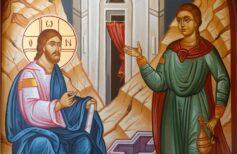
With the meeting with the Samaritan woman at the well, Jesus reveals his identity as Messiah and speaks revolutionary words,...
25 March 2026
What’s the Future of Religion?
What’s the Future of Religion?
A Beginner’s Guide to Christianity
A Beginner’s Guide to Christianity
Mind-Blowing Statistics About Christianity You Need to Know
Mind-Blowing Statistics About Christianity You Need to Know
8740
Enter the Holyart world: $20 discount voucher valid on over 60,000 items
Come and discover Holyart, the largest e-commerce of religious articles in Europe and immediately receive a $20 voucher to use with your first purchase.
Check your mailbox: you will receive your discount within 5 minutes