In the heart of Piedmont, in that nineteenth-century Turin poised between the roar of the first industries and the subdued cry of the poor, a new holiness blossomed. Not made of ecstasies or resounding miracles, but of hands soiled with soot, of steps consumed in the alleys, of looks that sought Christ in the face of the forgotten. They were the social saints, ardent souls who chose to live the Gospel among the wounds of the world. Women and men who made Savoy a living laboratory of charity and justice, transforming compassion into a daily practice. Unforgettable figures such as Don Bosco, Cottolengo, Giulia di Barolo and Pier Giorgio Frassati, capable of responding to misery with tenacity, to injustice with concrete works, to despair with the audacity of hope.
Even today, the social saints of 1800 and the twentieth century from Turin speak to us, in a world that has changed its poor, but not poverty, which has changed its forms of injustice but not its roots; their voice is more urgent than ever. They were not legendary heroes: they were men and women who chose to say yes to life, even when it was dirty, hurt, or uncomfortable. They did not change the world with slogans or power, but with the humble strength of those who love without measure.
Who are the social saints? They are the ones who do not run away from pain, but inhabit it. Those who build bridges, schools, hospitals, and relationships. Those who know that every gesture of charity is a prophecy, every embrace an announcement of resurrection. And perhaps, in our small way, we too can one day become social saints. Because holiness is not for the chosen few, but for those who dare to dirty their hands with love.
Who are the social saints? They are those who, driven by the Christian faith, did not accept that prayer remained closed in churches while outside, one died of hunger, cold or loneliness. In this article, we discuss the socialsaints of Piedmont, particularly those in Turin, who, between the nineteenth and twentieth centuries, transformed collective pain into a forge of holiness. They were not only benefactors but reformers of the collective soul. They not only created hospitals and schools, but also culture, dignity, and future. In no other city has such a constellation of social saints from the 1800s gathered, making it a unique case in the history of the Church.
They were priests and marquises, workers and students. Some came from palaces, others from farmhouses, but they all looked at the same horizon: a world in which no one was discarded. The Piedmontese saints were not content to give a piece of bread: they offered occasions, listening, and redemption. Their charity was intelligence, their zeal, and political vision. And their holiness, deeply embodied.
Turin, from a “city of priest eaters”, thus became the capital of social holiness. A paradox that tells how, right where cynicism seemed to reign, the purest flowers of active faith blossomed.
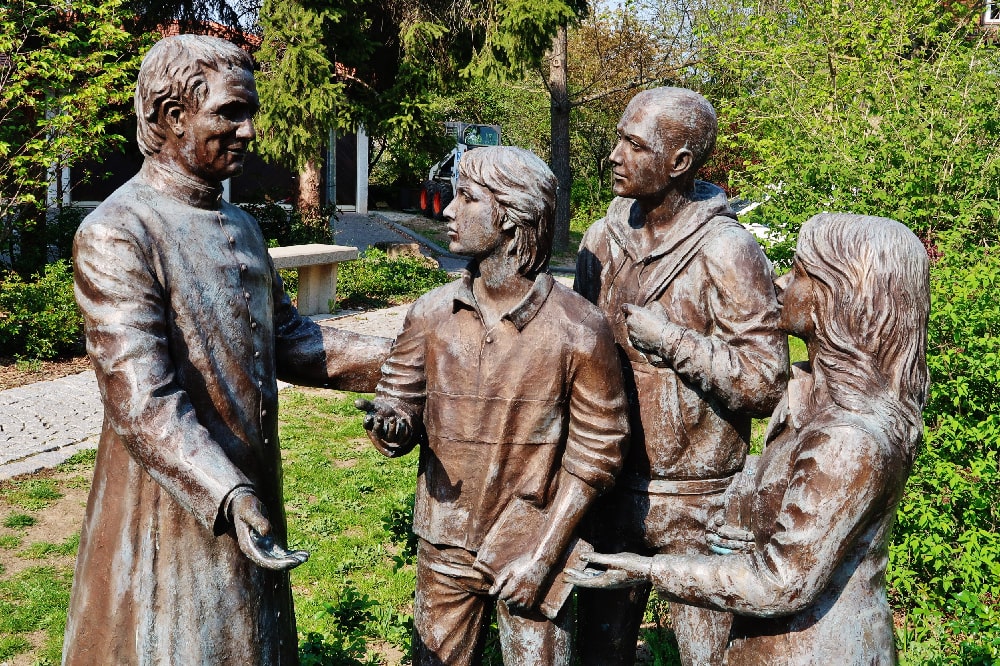
Giovanni Bosco, or simply Don Bosco, is the icon par excellence of the social saints of Turin. Born in 1815 in the hills of Castelnuovo, he bore in his eyes the sweetness of Monferrato and in his heart the temper of the prophets. When he arrived in Turin, the city was an industrial jungle where young people were swallowed up by factories and sent back to the streets, without education or hope. Don Bosco looked for them one by one, listened to them, and welcomed them. Thus, the oratory was born, a place that was not only a prayer but also a school, a play, and a future. His educational method, founded on reason, religion, and loving kindness, was a revolution: no punishments, only trust. “Here, holiness consists in being very cheerful”, he told his boys, returning to the faith and the smile of childhood.
He did not stop there: he founded professional schools, printers, and laboratories. He offered young people not only spiritual salvation, but also tools for living with dignity. And when he founded the Salesians, his dream multiplied in the world, becoming a universal work.
He died in 1888, and Turin mourned the loss of its father, the poor. He was canonised in 1934, but even before that, he was already alive in the hearts of millions of young people who, thanks to him, had rediscovered themselves.
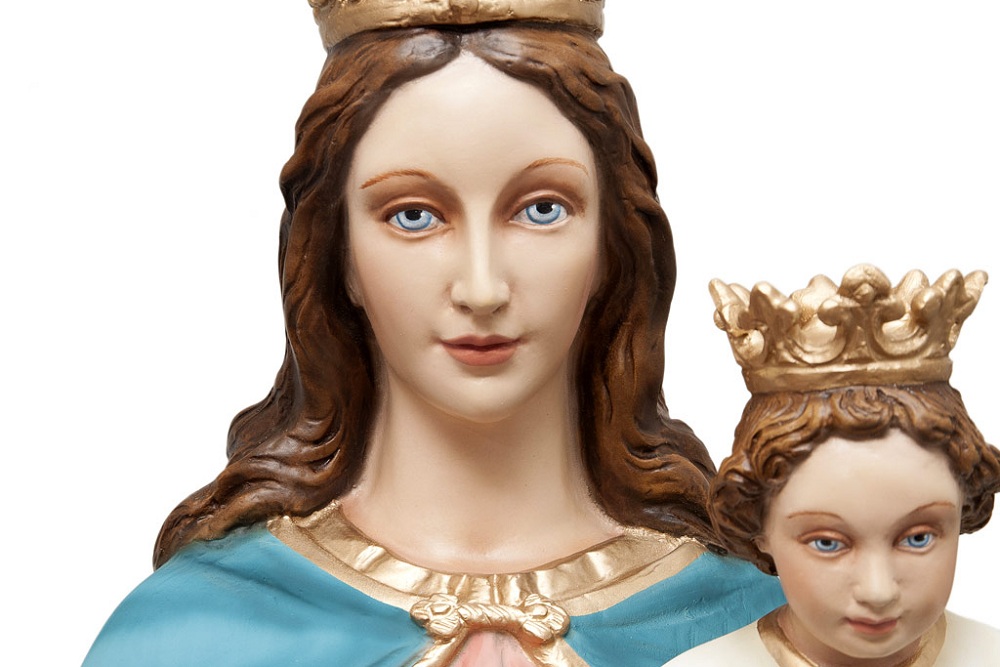
Statue of Saint John Bosco and Saint Dominic Savio in painted resin…
Pier Giorgio Frassati
Pier Giorgio Frassati is the fresh, modern and scandalously simple face of twentieth-century social sanctity. A tall, smiling young man, who climbed mountains and crossed poor neighbourhoods with the same light step, guided by a hunger for justice that gave him no respite.
Born in 1901 into a wealthy family, he could have easily settled into a life of privilege. Instead, he chose the narrow path, that of radical charity. If we ask ourselves who the social saints of Turin are, Pier Giorgio was the youngest and most surprising answer.
His room was a storehouse of clothes and medicines for the poor. His free time was dedicated to needy families. His coat? Donated. Your passion for politics? Always by the side of the last. He studied engineering, loved sports, prayed at dawn and served at night.
He died at the age of 24, almost in silence. But at his funeral, there were not only illustrious relatives: there were thousands of poor people, his true friends, those whom no one knew, but whom he had loved with heroic discretion.
Beatified in 1990, he is today the patron saint of young Catholics, but Pier Giorgio remains, above all, a topical example: one can be a saint without a halo, among universities, mountains, and subways, loving every day with silent ferocity.
This coloured resin statue of Pier Giorgio Frassati is finely crafted with great attention to detail…
Pier Giorgio Frassati will be canonised on Sunday, 7 September 2025. The news came on 13 June 2025, during the first Ordinary Consistory of Pope Leo XIV. He will be proclaimed a saint together withCarlo Acutis. A joint long-awaited canonisation that will unite two figures much loved by young people and the Church today. Initially, the date chosen for Frassati was 3 August 2025, but with the death of Pope Francis and the reorganisation of the jubilee events, everything was reorganised. The new calendar caused the ceremony to be postponed in September, on a Sunday that promises to be very well attended, especially by those who found inspiration in these two young, beautiful men. The canonisation will be held inRome, and a large turnout is expected, comprising students, scouts, educators, parish groups, and ordinary people. All united by the desire to pay tribute to two young people who have lived the faith in a simple, authentic and contagious way. Frassati and Acutis, although they are so different, share a commonality: Pier Giorgio, with his mountain excursions and commitment to serving the poor, and Carlo, with his talent for digital media and devotion to the Eucharist. Both have shown that you can live the Gospel in everyday life, without the need for striking gestures. Just put love into it.
7 September will not only be a day to remember for the faithful. It will be a strong signal: holiness is not a distant ideal, but something that can speak even today, even to young people, even to those who feel normal.
Alongside Don Bosco and Pier Giorgio Frassati, another figure emerges among the social saints of Piedmont: Giuseppe Benedetto Cottolengo. Born in Bra in 1786, he was a priest, theologian and tireless apostle of charity. Faced with the death of a poor woman rejected by hospitals, he understood that mercy cannot wait: he then opened a small infirmary that soon became the famous Little House of Divine Providence, known to all as the Cottolengo. His was a silent and radical revolution: unconditional welcome, absolute trust in Providence, integral care of the person. Disabled, chronically ill, orphaned, homeless, deaf-mute: no one was excluded, all were brothers. With his prophetic work, Cottolengo has anticipated modern welfare, offering not only assistance but dignity. Canonised in 1934, he continues to inspire those who believe that charity is not a gesture, but a way of life.
Giulia di Barolo
A feminine voice of Piedmontese social sanctity, Giulia Colbert Falletti of Barolo, demonstrated how a woman with a clear and courageous soul could transform nobility into service. Born in France in 1786, she became a marquise by marriage and mother of the poor by choice. Without children, she decided, along with her husband Carlo Tancredi, to dedicate her time, her palace, and her wealth to the last of Turin. Giulia was a pioneer, especially in the fields of female and prison assistance: she visited prisons, spoke with inmates, and offered them education, work, and faith. She founded the Rifugio, the first reintegration centre for ex-prisoners, and created schools, orphanages, kindergartens, and hospitals. Every day, she distributed food and care, but above all, dignity.
She didn’t just help: she built the future. She collaborated with Don Bosco and welcomed intellectuals and saints into her living room, including Silvio Pellico.
Today, she rests in the church of Santa Giulia, which she wanted. Her life was a seed planted in the heart of the city: a charity made not of isolated gestures, but of system, vision, love that is organised.
Giuseppe Cafasso
Among the great social saints of Piedmont, Giuseppe Cafasso holds a special place: that of a man who did not seek visibility but chose to stay behind the scenes, enlightening others. Born in Castelnuovo d’Asti in 1811, into a simple and profoundly devout family, he became a priest at a very young age. In Turin, at the Convitto Ecclesiastico di San Francesco d’Assisi, he trained generations of priests capable of living the faith in society, including a restless young man who would become Don Bosco.
His mission, however, took him even to the darkest places in the city: prisons. Cafasso entered the cells of the condemned with a light step and a firm voice, bringing comfort, listening, and mercy. He was called “the priest of the gallows” because he accompanied the condemned to death to the gallows, embracing their last hours with a tenderness that snatched them from despair. His presence was discreet, but essential: he brought bread, forgiveness, and dignity.
He did not found religious orders, nor did he leave material works, but his “foundation” was the consciences he touched, the hearts he raised, the priests he formed. He died in 1860, and the Church proclaimed him a saint in 1947, entrusting prisoners to him as their patron. His remains rest today in the Sanctuary of the Consolata, next to the people he has always loved. Cafasso is the silent face of social sanctity: the one that consoles, that educates, that accompanies without ever asking for anything in return.
The fragrances of Padre Pio represent just one of the most evocative aspects of the veneration surrounding this unique Saint....
26 August 2026
What’s the Future of Religion?
What’s the Future of Religion?
A Beginner’s Guide to Christianity
A Beginner’s Guide to Christianity
Mind-Blowing Statistics About Christianity You Need to Know
Mind-Blowing Statistics About Christianity You Need to Know
7816
Enter the Holyart world: $20 discount voucher valid on over 60,000 items
Come and discover Holyart, the largest e-commerce of religious articles in Europe and immediately receive a $20 voucher to use with your first purchase.
Check your mailbox: you will receive your discount within 5 minutes