Homepage | Religion | Saint Corbinian, the Saint Who Travelled to Rome with a Bear
Saint Corbinian, the Saint Who Travelled to Rome with a Bear
1 September 2025
Reading Time: 5minutes
Much beloved by Pope Benedict XVI, Saint Corbinian was a monk, hermit, and Bishop of Freising. At the Pope’s request, he evangelised Bavaria and even convinced a bear to accompany him to Rome. Here is his story.
Saint Corbinian, Bishop of Freising, was in his time a symbol of faith and dedication, and he remains highly venerated today in Bavaria and beyond. Pope Benedict XVI frequently referred to him as a model and even had the bear, the central figure of the famous legend associated with the Saint, featured on his papal coat of arms.
Saint Corbinian’s main merit was his crucial role in spreading Christianity throughout southern Bavaria. His life and contribution to the Church are remembered as an example of unwavering faith and commitment to the welfare of the community. His influence and efforts in evangelisation earned him the admiration not only of Pope Gregory II but also of the local people, including the Bavarian dukes. His missionary work among the region’s more feral Germanic tribes led to the construction of churches and monasteries that still bear witness to his legacy today. More recently, a parish and a church in Infernetto, Rome, have been dedicated to him, demonstrating how his influence has extended far beyond his native land.
His memory is celebrated on 8 September, the date of his death, and his legacy is reflected in the numerous churches, sculptures, and works of art dedicated to him in Bavaria and elsewhere.
Who Was Saint Corbinian
According to the Vita Corbiniani, written in 760 by Bishop Aribo of Freising, the fourth successor to Saint Corbinian in the Bavarian diocese, Corbinian of Freising was born in Châtres (Castrum) around the year 680. Baptised with his father’s name, Vadalgiso, he later adopted his mother’s name, Corbiniana. From an early age, he displayed a strong devotional spirit and an inclination towards monastic life, which he embraced following his mother’s death. He built a hermitage near the Church of Saint Germanus in his hometown.
His reputation for holiness quickly spread, and around twenty young men joined him. With them, Corbinian undertook a pilgrimage to Romeas a devotional act to Saint Peter, to whom he was particularly devoted. Pope Gregory II, impressed by the monk’s sanctity, summoned him and entrusted him with the evangelisation of the Bavarian territories—still home to many pagan tribes—and appointed him Bishop of Freising.
Saint Corbinian accepted the charge and spent years travelling across the region, often through inhospitable and wild areas. Eventually, he decided to return to Rome to ask the Pope to relieve him of his duties. His request was denied, and instead, he was asked to settle in Freising. There, Corbinian collaborated closely with the Duke of Bavaria, Grimoald, thanks to whom he founded the monastery of Saint Stephen, his episcopal seat.
When relations with the Duke deteriorated—fuelled by the hatred of Grimoald’s wife, Pilitrude, who even attempted to have the monk killed—Corbinian chose to withdraw to the tomb of Saint Valentine at Maia and Caines, near Merano.
He was later recalled to Freising by Grimoald’s successor, returning there only to die shortly thereafter. He requested to be buried in the small church of Saint Zeno in Maia (Merano). His relics were later translated to Freising.
The Bear of Saint Corbinian
Among the legends associated with Saint Corbinian, the most famous is that of the bear who accompanied him on his second journey to Rome. The animal had attacked the monk, killing the donkey that carried his belongings. Instead of fleeing, Corbinian scolded the bear and ordered it to pull the cart as penance for its actions. Repentant, the bear allowed itself to be harnessed and accompanied the Saint to Rome, carrying his belongings like the gentlest of pack animals.
This episode has become a symbol of spiritual mastery over the wild and represents the triumph of faith and God’s will over earthly challenges. The image of the bear pulling Saint Corbinian’s cart is often depicted in art and iconography associated with the Saint, symbolising Corbinian’s strength of faith in his missionary work and his ability to transform adversity into an opportunity for spiritual growth.
The bear is the symbol of the miracle performed by Saint Corbinian of Freising….
The Bond Between Pope Benedict XVI and Saint Corbinian
As mentioned, Pope Benedict XVIchose to have the image of Saint Corbinian’s bear on his papal coat of arms. But the parallels between Joseph Ratzinger and the Saint do not end there. The connection between Pope Benedict XVI and Saint Corbinian is deeply rooted in the history and spirituality of Bavaria, where Ratzinger was born and raised, and where the cult of Saint Corbinian has long been prominent.
Ratzinger developed a deep affection for Saint Corbinian from a young age, having grown up in the town of Marktl am Inn, near Freising, where the Saint had served as bishop. During his episcopal ordination on 28 May 1977 at the Cathedral of Munich, Ratzinger made his affinity with Saint Corbinian clearly known. This bond had a significant impact on Ratzinger’s life and career. From 1977 to 1982, he led the Archdiocese of Munich and Freising, allowing him to continue the spiritual tradition of Saint Corbinian in the region.
Even during his pontificate as Pope Benedict XVI, Ratzinger continued to recognise Saint Corbinian as a model of dedication to the Church—he who gave up the life of a monk and hermit to answer the Pope’s call to preach the Gospel among the people.
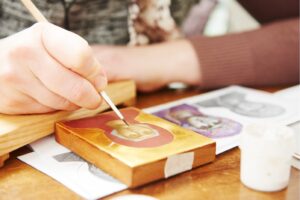
Sacred icons: genuine expressions of religiosity, symbolic works that transcend art. How are they painted? Discovering egg tempera Much of...
2 March 2026
What’s the Future of Religion?
What’s the Future of Religion?
A Beginner’s Guide to Christianity
A Beginner’s Guide to Christianity
Mind-Blowing Statistics About Christianity You Need to Know
Mind-Blowing Statistics About Christianity You Need to Know
7592
Enter the Holyart world: $20 discount voucher valid on over 60,000 items
Come and discover Holyart, the largest e-commerce of religious articles in Europe and immediately receive a $20 voucher to use with your first purchase.
Check your mailbox: you will receive your discount within 5 minutes