Homepage | Religion | Saint James the Apostle: The Story Behind the Saint of the Famous Pilgrimage Route
Saint James the Apostle: The Story Behind the Saint of the Famous Pilgrimage Route
16 July 2025
Reading Time: 7minutes
Saint James the Apostle was one of Jesus’ closest disciples. The first of the Apostles to suffer martyrdom, he still guides thousands of pilgrims along the path that bears his name
The brother of the Apostle John and, with him, the first to follow Jesus, Saint James was also the first among the Apostles to die a martyr during the persecution led by Herod Agrippa I. Jesus called him and his brother “Sons of Thunder”, either because of their fiery temperament or because they once asked for a village that refused hospitality to Jesus to be destroyed by fire from heaven (Luke 9:51–56).
What we know for certain is that Saint James was one of Jesus’ closest companions, present at some of the most pivotal moments of His earthly ministry: the Transfiguration, the resurrection of Jairus’ daughter, and Jesus’ final night in Gethsemane.
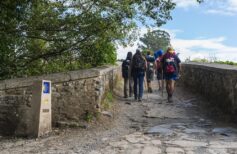
Today, he is also remembered for the pilgrimage route named after him, the Camino de Santiago, which has drawn pilgrims from across the centuries to the site of his tomb.
According to legend, after Jesus’ death, Saint James set out to spread His Word and traveled as far as the Iberian Peninsula—far from where he and his companions began their mission. Upon returning to Jerusalem, he was arrested and executed on the orders of King Herod, grandson of Herod Philip the Tetrarch, who had previously ordered the beheading of John the Baptist, James’ former mentor.
Legend has it that a boat guided by an angel brought Saint James’ decapitated body from Judea to the coast of Galicia. His remains were buried in the place where the Cathedral of Santiago (Saint James) de Compostela now stands.
It’s important to note that several figures named James appear in the New Testament. Besides James son of Zebedee, there’s also James son of Alphaeus, known as the Lesser, and James the Just, also known as the brother of the Lord.
Saint James’ story is closely linked to that of his brother John, who was also an Apostle. James and John were the sons of Zebedee and Salome. They were born in Bethsaida, a village in Galilee on the shore of the Sea of Gennesaret, and worked as fishermen from a young age.
Before meeting Jesus, they were disciples of John the Baptist, who ultimately pointed Jesus out to them. James and John thus became Jesus’ first disciples, even before Peter and his brother Andrew. The Gospels and the Acts of the Apostles show that James and John were especially close to Jesus during His public life.
James in particular had a passionate and ambitious character. He believed his closeness to Christ would earn him a privileged role in the Kingdom He would bring to Earth—so much so that he dared to ask Jesus directly. But when Jesus promised they would share in His fate, He was referring to martyrdom—and so it came to pass.
After returning to Palestine from Spain, James played a key role in the early Christian community in Jerusalem. Along with the Twelve Apostles, he became a foundational figure of the early Church, actively spreading the Gospel in the Holy City. Despite growing hostility toward Christianity and official bans on preaching, James continued to proclaim the Word, entering synagogues and interpreting the prophets.
His powerful oratory, persuasive dialogue, and charismatic presence made him one of the most followed Apostles. However, his fiery preaching and leading role did not go unnoticed. Herod Agrippa I, seeking to appease the religious authorities and curry favor with the Jews, targeted James as a symbol of the nascent Christian faith.
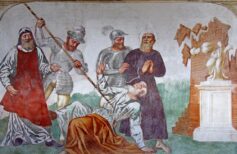
According to tradition, the scribe Josias, tasked with escorting James to his execution, witnessed a miracle: while on the way to the site, a paralyzed man begged James for help and was miraculously healed. Deeply moved, Josias repented and converted to Christianity. As his final wish, James asked for a bowl of water to baptize Josias. Both were then beheaded.
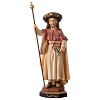
Statue made in Val Gardena, Italy, sculpted in maple wood…
The Link to the Camino de Santiago
The story of Saint James of Compostela begins after Jesus’ death and resurrection, when the Apostle left Judea and traveled to Spain to preach the Gospel. After his martyrdom, his lifeless body was brought back to Spain and buried in a secret location.
Centuries later, a hermit named Pelagius wandering on Mount Liberon arrived at a plateau where starlike lights shimmered. It was a necropolis, and among the tombs was that of Saint James, marked with the inscription: “Here lies Jacobus, son of Zebedee and Salome.”
The site began to be known as Campus Stellae, or “Field of the Star”—hence the name Compostela.
After King Alfonso II of Asturias made a pilgrimage to Compostela in 825 AD, many others followed. The basilica dedicated to the saint began construction in 1075, and Compostela quickly became one of the most important pilgrimage destinations in Christendom.
Since the Middle Ages, the Sanctuary of Saint James in Compostela has been one of the most sought-after pilgrimage sites in Europe.
One of the symbols of the Camino de Santiago is the scallop shell, known as the “Concha de Santiago”. In medieval times, pilgrims would carry a shell collected from the beaches of Finisterre—then believed to be the end of the known world (from the Latin Finis Terrae).
Legend holds that the disciples of Saint James, after losing his remains in a shipwreck, recovered them on that very beach, covered in shells.
The leather shell-shaped keyring is made of genuine leather and…
Even today, the Camino de Santiago—with its various routes converging on the Spanish city—remains a spiritually meaningful journey. People walk it for religious reasons, as an act of faith, in search of forgiveness and redemption, or to experience personal growth and deeper connection with themselves and others.
The Camino of Saint James in Sicily
The cult of Saint James in Sicily, with its many churches, hospitalia, and Francigena routes, reflects the island’s deep connection to the pilgrimage to Santiago de Compostela. It highlights Saint James’ importance as the protector of pilgrims and a figure of devotion in Sicilian tradition.
The cult of Saint James spread significantly after the Norman conquest in the 12th century. Numerous churches dedicated to the saint were built across the island as evidence of fervent popular devotion.
On July 25, 1090, Count Roger I of Sicily liberated the city of Caltagirone from the Saracens and had a dream in which Saint James appeared to him as a “Matamoros” (Moor-slayer), wielding a sword later called “the sword of Saint James.”
As a result, a church was built in Caltagirone, and Saint James became the city’s patron saint. Seven churches were later established from it, symbolizing seven rays of light.
Other Sicilian towns—such as Palermo, Caccamo, Enna, Piazza Armerina, Syracuse, Ferla, Ragusa, Gela, Vizzini, Mineo, and Augusta—are also home to churches dedicated to Saint James, dating back to the early 14th century.
Many of these had hospitalia, or hostels for pilgrims, managed by knightly orders such as the Templars, Teutonic Knights, and Hospitallers.
These hospitalia, spaced roughly 30 kilometers apart along key medieval routes, provided pilgrims with food, rest, and care before they resumed their journey at dawn.
Today, the Sicilian Camino of Saint James stretches from the city of Caltagirone to the picturesque mountain town of Capizzi. These two communities are the oldest and most devoted centers of Jacobean tradition on the island, and both preserve important relics of the saint.
The route begins at the ancient Basilica of Saint James in Caltagirone and ends at the Norman-era sanctuary in Capizzi, dating to the 13th century and considered the oldest Jacobean site on the island.
The path spans roughly 130 kilometers, passing through seven towns and showcasing an extraordinary variety of landscapes that change with the seasons.
Travelers encounter rich natural, historical, mystical, and anthropological experiences at every turn. The heart of Sicily reveals its splendor, welcoming pilgrims on a journey of both discovery and introspection.
On the fourth Sunday of Easter, the liturgy celebrates Jesus the Good Shepherd. Where does this image of Christ originate?...
9 March 2026
What’s the Future of Religion?
What’s the Future of Religion?
A Beginner’s Guide to Christianity
A Beginner’s Guide to Christianity
Mind-Blowing Statistics About Christianity You Need to Know
Mind-Blowing Statistics About Christianity You Need to Know
7320
Enter the Holyart world: $20 discount voucher valid on over 60,000 items
Come and discover Holyart, the largest e-commerce of religious articles in Europe and immediately receive a $20 voucher to use with your first purchase.
Check your mailbox: you will receive your discount within 5 minutes