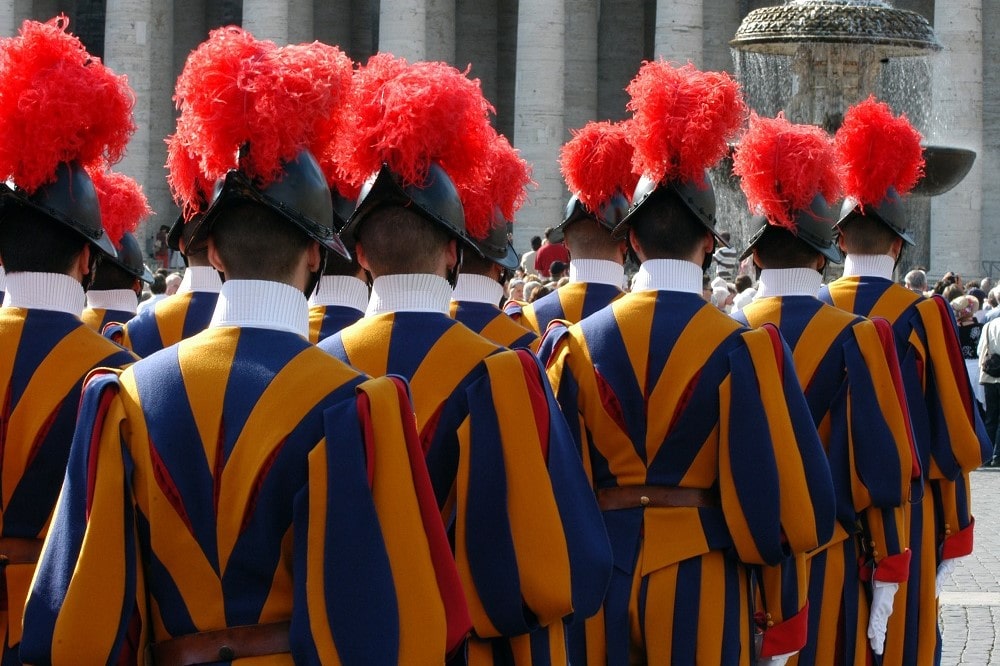
For five hundred years, the Swiss Guards have protected the Pope’s security and watched over the Vatican. Here is who these men in their picturesque yellow, red and blue uniforms are
The Swiss Guards, also known as the Papal Guards or Pontifical Swiss Guard, are one of the oldest and most fascinating institutions in the world. Founded in 1506, these guards are tasked with protecting the Pope and the Vatican. With the approach of the 2025 Jubilee, their role is more relevant than ever.
This particular armed corps, unique of its kind, is the oldest permanent corps in the world. In fact, apart from some interruptions in service, the Swiss Guards have remained on guard in the Vatican and, in particular, over the person of the Holy Father continuously for five centuries, always Acriter et fideliter, “With courage and faithfulness”, as their motto says.
The main function of the Pope’s guards is the protection of the Holy Father, both inside the Vatican and during his travels. This responsibility includes security during papal audiences, liturgical celebrations and apostolic journeys. In addition to protecting the Pope, the Vatican Guards ensure the security of the Vatican City State. This includes access control and surveillance in sacred places and at strategic points within the small State.
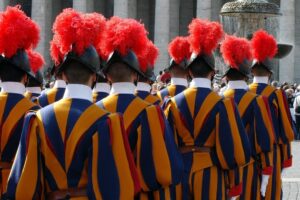
The Swiss Guards also play a leading role in numerous Vatican ceremonies and traditions. Their colourful uniform, which recalls their Renaissance origins, is recognised throughout the world. Although it has been erroneously attributed to Michelangelo, this uniform was designed at the beginning of the 20th century by Commander Jules Repond. Inspired by Renaissance clothing and the works of Raphael, it includes the colours of the coats of arms of Pope Julius II della Rovere (yellow and blue) and Pope Clement VII of the Medici family (red), and symbolises the corps’ long history and traditions.
Particularly significant is the Oath of the Swiss Guards, which is held every year on 6 May. During this ceremony, new recruits swear loyalty to the Pope and promise to defend him with their own lives with this formula, which recalls ancient knightly orders governed by solemn codes of honour and courage:
“I swear to serve faithfully, loyally and honourably the Supreme Pontiff (name of the Pontiff) and his legitimate successors, as well as to devote myself to them with all my strength, sacrificing, if necessary, even my life in their defence. I likewise undertake these commitments with regard to the Sacred College of Cardinals for the duration of the vacancy of the See. I further promise the Commander and my other superiors respect, loyalty and obedience. I swear to observe everything that the honour of my position requires of me.”
With the approach of the 2025 Jubilee, the role of the Swiss Guards will be particularly intense. The Jubilee is an extraordinary event that attracts millions of pilgrims from all over the world. The Swiss Guards will be engaged in ensuring security during celebrations, processions and papal visits, and will have to manage large crowds and protect holy places.
But what do the Swiss Guards do? Why is the Pope protected by them? How did this picturesque corps come into being?
Why is the Pope protected by the Swiss Guards? The primary function of the Pope’s guards is to ensure the safety of the Holy Father. This task includes protection during papal audiences, liturgical celebrations and apostolic journeys. The Swiss Guards are always present to ensure that the Pope is safe at all times.
Pope Francis expressed his gratitude and admiration for the Swiss Guards on several occasions. The Pontiff emphasised the importance of their service, not only as a security force, but also as a symbol of dedication and faith. The Swiss Guards, with their discreet yet determined presence, represent a fundamental element of Vatican life.
To carry out their task of protecting the Pontiff as effectively as possible, the Swiss Guards are militarily trained and equipped with modern portable firearms, as well as traditional halberds, which serve as a ceremonial element. In addition to ensuring the Pope’s security, the Swiss Guard works with the Gendarmerie of the Vatican City State to oversee ceremonies in St Peter’s Basilica and the Paul VI Audience Hall. They also check and filter access to the Vatican. Furthermore, during periods of papal election, they protect the College of Cardinals engaged in the Conclave.
this department is entirely dedicated to Pope Jorge Mario Bergoglio.
Why are the Swiss Guards called that?
It is very simple: to become Swiss Guards, the first indispensable requirement is to be Swiss citizens! The Swiss Guards therefore owe their name to their geographical origin. They were in fact established in 1506 by Pope Julius II della Rovere. At that time in history, Switzerland, with its army of highly trained and disciplined soldiers, supplied mercenaries to various European sovereigns. Swiss mercenaries were renowned for their skill and loyalty in battle, and their reputation as fearless and faithful fighters made them particularly sought after.
On 22 January 1506, the first contingent of 150 Swiss soldiers led by Captain Kaspar von Silenen, from the Canton of Uri, entered Rome to begin their service as personal guards of Pope Julius II, who placed great trust in their loyalty and military skill. In fact, in previous years, other pontiffs had already reached agreements with the Swiss Confederation, but Pope Julius II is considered the founder of the corps.
In May 1527, the terrible Sack of Rome took place, carried out by the German Landsknechts in the service of Charles V of Habsburg. It was one of the worst and most brutal attacks on the Eternal City, and forced the Pope at the time, Clement VII de Medici, to take refuge in Castel Sant’Angelo on 6 May. Covering his escape were 189 Swiss Guards, 147 of whom lost their lives to bring the Pontiff to safety. For this reason, the solemn Oath of the Swiss Guard is traditionally celebrated on 6 May, in the San Damaso Courtyard, in memory of those heroic guards.
Subsequently, the Swiss Guard was rebuilt through the efforts of Cardinal Ennio Filonardi. Dissolved several times during the Napoleonic invasions, the Swiss Guard continued to carry out its task of protecting the Pope and the Vatican palaces, gradually losing its military dimension to assume a more ceremonial one.
In the first decade of the 20th century, Commander Jules Repond promoted a profound reform of the Swiss Guard corps, imposing the requirement that only Swiss citizens who were militarily trained could be recruited. Since 1970, with the suppression of the Pontifical Noble Guard, the Swiss Guard has remained the only corps to hold the role of ceremonial guard in the Vatican. Following the attempted assassination of John Paul II on 13 May 1981, the Swiss Guards were once again elevated from a simple ceremonial corps to a genuine military corps adequately equipped with modern weapons.
To celebrate the beatification of Pope John Paul II we created a department…
What do the Swiss Guards do?
The Swiss Guards carry out a series of crucial tasks for the security and functioning of the Vatican. Operating seven days a week and 24 hours a day, these guards are ready to intervene at any moment to protect the Pope and the Vatican.
Their main task is to ensure the safety of the Holy Father, both inside the Vatican and during his travels.
The Swiss Guards ensure the security of the Vatican City State, monitoring access and keeping watch over sacred places and strategic points. They are responsible for preventing and responding to any security threats.
Since 2016, the Swiss Guards have had an operations centre that gathers all the information necessary to carry out their duties. This control centre allows for a rapid and effective response to any emergency situation.
To ensure coverage of all the services required, the number of guards was increased from 110 to approximately 135 men. This reform ensures that there is always an adequate number of personnel available for every need.
The Swiss Guards receive rigorous training to prepare them for any emergency situation. This training includes military training, self-defence techniques and security protocols.
“Anyone who decides to dedicate his life or some years to the Swiss Guard therefore also accepts, in extremis, to sacrifice his life for the Pope.” This is what Lieutenant Urs Breitenmoser, then media officer of the Swiss Guards, stated a few years ago. For five centuries, this corps of Guards, unique in the world, has existed to serve and protect the Holy Father at the cost of their own lives.
To join the Swiss Guards, it is necessary to meet specific requirements. As we have already seen, one must be a citizen of Switzerland, and only single men between 19 and 30 years of age may apply. Applicants are required to be practising members of the Catholic religion and to have completed military service in the Swiss Army with a certificate of good conduct. The minimum height required is 174 centimetres. Marriage is permitted only after five years of service and upon reaching 25 years of age. A certificate of professional competence or a secondary school diploma is required.
The training of the Swiss Guards is military in nature. The guards receive instruction in various martial arts disciplines to improve their self-defence skills. The use and maintenance of firearms are an integral part of their training. The guards are also trained in the use of shooting weapons, to ensure that they are fully prepared for different security situations.
The Sanctuary of San Gennaro in Pozzuoli, a place of worship and pilgrimage for all devotees for centuries The miracle...
9 September 2026
What’s the Future of Religion?
What’s the Future of Religion?
A Beginner’s Guide to Christianity
A Beginner’s Guide to Christianity
Mind-Blowing Statistics About Christianity You Need to Know
Mind-Blowing Statistics About Christianity You Need to Know
9502
Enter the Holyart world: $20 discount voucher valid on over 60,000 items
Come and discover Holyart, the largest e-commerce of religious articles in Europe and immediately receive a $20 voucher to use with your first purchase.
Check your mailbox: you will receive your discount within 5 minutes