Let us explore together the profound meaning and importance of the Sacrament of Reconciliation in the Christian faith. The crucial role of the priest, the Act of Contrition and the importance of preparation for this sacramental encounter, which brings with it the gift of forgiveness and reconciliation with God and with one’s neighbour
The Sacrament of Reconciliation, also known as the Sacrament of Penance or the Sacrament of Confession, represents a fundamental moment in the spiritual life of a Catholic believer. It is, in fact, the moment when he or she receives forgiveness for sins, restores communion with God and with brothers and sisters in the Christian community and has the opportunity to renew their commitment to a more righteous and holy life. The moment of religious confession brings with it the remission of sins and a sense of liberation and reconciliation with God. It is a moment of grace and spiritual renewal, which strengthens the penitent’s relationship with God and encourages them to pursue a life of virtue and holiness.
The Sacrament of Reconciliation is first and foremost an act of humility and repentance, which allows us to receive the merciful forgiveness of God and the Church for our sins, and thus becomes the ordinary means of obtaining remission of grave sins committed after Baptism.
This Sacrament is not merely a formal act, but a true journey of grace and conversion, a special encounter with God’s infinite love. Through it, we have the opportunity to humbly acknowledge our mistakes, repent of our wrong actions and ask for divine forgiveness. It is a moment of intimate communion with God, in which we submit ourselves to his merciful judgement and entrust ourselves to his infinite compassion. It is a moment of inner purification and spiritual renewal, in which we free ourselves from the burden of our sins and renounce evil in order to embrace good.
Thanks to the Sacrament of Penance and Reconciliation, everyone has the opportunity to start again and resume their journey along the path of holiness and eternal life, freed from every fault and aware of God’s loving and merciful presence in our lives.
Already in Jewish culture and in the Old Testament, there was the Day of Atonement. On this day, the sins of the people of Israel were confessed, in a general form, and two goats were sacrificed, symbolically bearing all the sins, one at the Temple of Jerusalem and the other in the desert.
With the advent of Christianity, the Church taught that through Baptism, those newly converted to the Catholic faith received remission of all their previous sins. The Sacrament of Penance was subsequently instituted to remit sins committed after Baptism.
In the first centuries of the Church, some sins were considered so serious that those who had committed them were subject not only to exclusion from the Eucharist, but also to being banned from the religious and human community until the fault had been expiated through fasting and penances. We are talking about sins such as idolatry, murder and adultery.
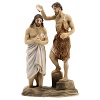
The statues reproduce the scene of the life of Jesus in which he is baptized by John the Baptist.
Subsequently, around the 7th century, the Church introduced tariffed penance, which involved rites of atonement carried out privately rather than publicly. The penance varied according to the nature and seriousness of the sin confessed, and forgiveness could be granted by an ordinary priest, not necessarily by the Bishop. Penitential books, known as “tariffs”, were created, listing for each type of sin the form of penance to be followed.
In the 11th century, with the Gregorian Reform, the penitentials were abolished and replaced by the Summae Confessorum, which provided guidance on how to re-educate the penitent through the practice of certain virtues.
Around the 12th century, the doctrine of indulgences allowed sinners the partial or total remission of temporal punishment through certain spiritual practices or works of charity. This method lent itself to abuses and corruption, which led to new reforms concerning confession and penance, especially after the Council of Trent.
The most recent dates back to 1984, the apostolic exhortation Reconciliatio et paenitentia issued by Pope John Paul II.
The moment of confession requires a certain amount of preparation and understanding of the steps to be followed. The examination of conscience is an important part of preparation for confession, as it helps the penitent to identify the sins to be confessed. This may include sins of omission and commission, sins against God and against one’s neighbour, as well as sins of thought, word and deed. A practical guide to the examination of conscience can be useful to ensure that no sins to be confessed are forgotten.
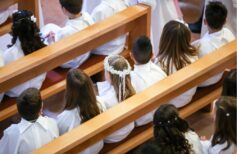
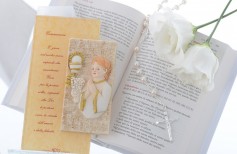
The First Confession precedes First Communion, and is a very significant moment in the life of a young Catholic believer. It is important that children are adequately prepared for this Sacrament, that they learn to reflect on their sins, sincerely repent and avoid committing them in the future. Above all, they should be aware that, for the first time, they will be able to experience the immensity of God’s love and forgiveness. For this reason, it is important to explainconfession to children. Preparation may include reflection, examinations of conscience and discussion with one’s spiritual guide.
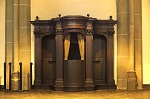
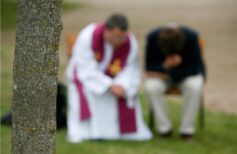
After entering the confessional and greeting the priest, the penitent can begin by sincerely and fully confessing their sins. The priest, acting as an intermediary of God, offers spiritual advice and imparts sacramental absolution.
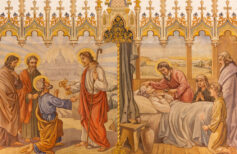
Jesus gave the apostlesand their successors the task and authority to act as intermediaries in the ministry of Reconciliation. The priest acts as God’s instrument in the Sacrament of Reconciliation, transmitting divine mercy and forgiveness to the penitent and helping them to experience the joy and freedom that come from reconciliation with God and with the ecclesial community. His role is fundamental and is manifested in various stages of the Sacrament itself.
The priest welcomes the penitent with love and respect, creating an environment of trust and sincerity. He listens patiently and compassionately to the confession of sins, showing understanding for the difficulties and challenges that the penitent may have faced. He guides them in recognising their sins and reflecting on their spiritual life. He offers spiritual and practical advice to help the penitent overcome their weaknesses and live a life more in accordance with the Gospel.
After the penitent has confessed their sins and expressed sincere repentance, the priest pronounces the words of absolution, through which God forgives sins and restores communion with the penitent. This act of mercy is a tangible sign of God’s infinite love for every person.
Finally, after imparting absolution, the priest offers words of comfort and support to the penitent, encouraging them on their journey of conversion and sanctification. He urges them to live a life of love and faithfulness to God and to others, promising his prayer and spiritual support.
Prayer after confession
After receiving absolution and forgiveness for sins, it is important to take a moment to thank God for his mercy and reflect on one’s commitment to living a life of holiness. Many people choose to recite a prayer after confession, such as the Act of Contrition or the Our Father, to express their gratitude and renew their commitment to God.
Made in Italy by a company specialised in high-quality jewellery.
The Act of Contrition, or Actus Contritionis, is often recited during the Sacrament of Reconciliation, before absolution.
This prayer is an intimate and personal moment in which the faithful person expresses before God their sincere repentance for their sinful actions. Through the Act of Contrition, the penitent acknowledges the offence inflicted upon God and their neighbour because of their sins, and expresses the desire to change their life, abandon evil and follow the path of virtue.
The Act of Contrition reflects the sinner’s awareness of their own fragility and of the need to turn to divine mercy in order to obtain forgiveness and reconciliation, and prepares the penitent’s heart to receive sacramental absolution and to experience the liberation and inner peace that come from God’s forgiveness.
Here is how to recite it:
My God, I repent and am sorry with all my heart for my sins,
because by sinning I have deserved your punishments,
and much more because I have offended You,
infinitely good and worthy of being loved above all things.
With your holy help I resolve never to offend You again
On 28 October the Church celebrates the joint liturgical memorial of Saint Simon the Zealot and Saint Jude Thaddeus. Here...
14 September 2026
What’s the Future of Religion?
What’s the Future of Religion?
A Beginner’s Guide to Christianity
A Beginner’s Guide to Christianity
Mind-Blowing Statistics About Christianity You Need to Know
Mind-Blowing Statistics About Christianity You Need to Know
9506
Enter the Holyart world: $20 discount voucher valid on over 60,000 items
Come and discover Holyart, the largest e-commerce of religious articles in Europe and immediately receive a $20 voucher to use with your first purchase.
Check your mailbox: you will receive your discount within 5 minutes