Homepage | Religion | The catechism: how to prepare for the Sacraments
The catechism: how to prepare for the Sacraments
7 October 2026
Reading Time: 7minutes
The catechism is much more than simply preparing to receive the Sacraments of the Catholic Church; it represents a journey of discovery and deepening of the faith that involves every aspect of spiritual and everyday life
The catechism is a fundamental stage in the spiritual formation of Catholic faithful. Without it, it would not be possible to receive the Sacraments, nor to lead an existence that is truly conscious from a religious point of view. The catechism, in fact, offers an in-depth guide to the precepts of the Church, spiritual life and religious practice. It represents the very heart of the doctrine of the Catholic Church, to whose fundamental precepts the faithful are introduced.
The etymology of the term catechism itself points to its purpose. It derives from the Greek “katechéo”, meaning “to instruct orally”, “to instruct with the voice”, and the importance of the oral transmission of the faith, and the central role given to teaching and communication in the religious formation of believers, immediately becomes clear. Over the centuries, the catechism has taken different forms and adapted to cultural and historical contexts, while always maintaining its principal purpose: to educate and form the faithful in the Christian faith.
Catechesis is therefore a form of basic religious instruction, given orally by a guide, who may be a priest, but also an educator, a parent or anyone else belonging to the religious community and possessing the knowledge to be communicated. The catechist is the person who takes responsibility for this transmission of knowledge and precepts of faith.
It was Jesus Himself who emphasised the importance of the catechumenate, that is, the journey of faith necessary to receive Baptism. He entrusted the Apostles with the task of teaching His precepts to new disciples, before baptising them, instructing them to observe His commandments, as reported in the Gospel according to Matthew: “Go therefore and make disciples of all nations baptising them in the name of the Father, and of the Son, and of the Holy Spirit, teaching them to observe all things that I have commanded you. And behold, I am with you always, until the end of the age.”(Matthew 28:19-20)
The Apostles followed this recommendation, and in the New Testament we read of many examples of catechetical teaching provided to converts before Baptism.
The statuettes reproduce the scene from the life of Jesus in which he receives baptism from John the Baptist.
In the first centuries of the Christian era, schools dedicated to catechesis began to emerge, the process of religious formation offered to those who wished to profess the Christian faith.
After the first centuries of the history of the Church, during which Baptism was usually administered in adulthood, through a triple immersion in water and the use of chrism, Baptism gradually began to be administered in very early childhood.
This change was accompanied by the transmission of the faith through Christian education, which was entrusted mainly to the family, the parish and society. In this new context, preparation for the Sacraments of Christian life, such as Communion, Confirmationand Marriage, became an integral part of the faithful’s formation journey.
Catechism can begin from the earliest age, with programmes specifically designed for pre-school children. However, it is common to begin catechesis in preparation for the Sacraments of Christian initiation: First Communion and Confirmation.
Usually, the catechetical journey begins when the child reaches the third year of primary school, and extends over five years. In the first two years, the focus is on preparation for First Communion, while in the following three years preparation is for Confirmation.
After receiving the Sacrament of Confirmation, young people are encouraged to continue their journey of spiritual growth by participating in parish youth groups or Scout groups.
The two Sacraments of First Communion and Confirmation represent significant milestones along young people’s journey of faith, while the optional continuation of the journey through youth groups or Scout groups allows them to put Gospel values into practice in everyday life and to develop a sense of belonging to the Church and the Christian community.
5 “Catechesis is an education in the faith of children, young people and adults, which includes in particular the teaching of Christian doctrine, generally given in an organic and systematic manner, with the aim of introducing them to the fullness of Christian life”.
This is what point 5 of the Italian Catechism of the Catholic Church states, the official and updated exposition of Catholic doctrine approved by Pope John Paul IIwith the apostolic constitution Fidei Depositum in 1992, and which then assumed its definitive form in 1997 with the apostolic letter Laetamur Magnopere.
The purpose of catechism is to guide the faithful in their spiritual experience, helping them to understand and live the precepts of the Catholic Church in their everyday lives. Through a deeper understanding of the faith, the faithful are able to live a more authentic and conscious Christian life. Through catechism, they are integrated into the life of the Church and the Christian community, and the sense of belonging and communion among the members of the family of faith is strengthened.
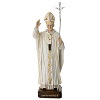
To celebrate the beatification of Pope John Paul II we created a department…
Catechism aims to teach and transmit the Christian faith, providing a solid foundation for understanding Catholic doctrine, but not only this. In addition to intellectual knowledge of the faith, catechism aims to foster the spiritual growth of the faithful, helping them to develop a personal relationship with God and to deepen their prayer and devotional life.
Furthermore, catechism offers moral guidelines based on Gospel principles and the tradition of the Church, helping believers to discern good from evil and to live according to Gospel values in their daily lives.
We have mentioned the fundamental importance of catechism in preparation for the reception of the Sacraments, in particular Communion and Confirmation, but also Baptism, when it is received by an adult, and Marriage and Ordination. Each Sacrament is explored in terms of its meaning and the importance it holds.
How to explain catechism to children
Catechesis for children is essential for introducing them to the Christian faith in an understandable and engaging way. Through specially designed catechism books and targeted lessons, children learn the foundations of the Catholic faith and develop a personal relationship with God. Ideally, the catechism experience should be presented from the outset as a wonderful adventure, a journey to undertake with the catechist and their peers, a path of discovery and encounter with Jesus. At the end of this journey we will have learnt to live, love and make choices inspired by His example, and we will be ready for great things.
The catechist, whether male or female, is a travelling companion and guide, and will help us to recognise Jesus not only through books and texts, but above all through the experiences we will share.
We go to catechism because it is important: it helps us to grow in faith, to learn to live as good Christians, and to prepare for Communionand Confirmation. We can learn more about the Church, of which we too are a part, and make friends with those who are following the same path as us. We bring with us the catechism book, a notebook, a pen and the Gospel, but above all the desire to learn and to participate actively. Catechism is not just a lesson to listen to, as at school, but an opportunity to talk and discuss, expressing our ideas.
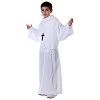
This category is entirely dedicated to albs and gowns for the First Communion Sacrament.
How the Catechism of the Catholic Church is structured
The catechism is designed to be a complete and accessible tool for teaching the faith, a safe and authoritative guide for Catholic faithful on their journey of spiritual growth. The new Catechism of the Catholic Church, approved in 1997, is the result of a process of work by the commission entrusted with its drafting and its doctrinal value.
It is structured into four main parts, each of which addresses a fundamental aspect of the Catholic faith: the Profession of Faith (Creed), which explores the fundamental principles of the Christian faith, outlining the profession of Catholic faith through the Apostles’ Creed, and delving into the doctrine of the Trinity, creation, redemption, sin and forgiveness, as well as the role of the Church as guardian of the faith; the Celebration of the Christian Mystery (Liturgy), which deals with the practice of the faith through the liturgy and the sacraments; Life in Christ (Morality), which presents the moral teachings of the Church, exploring how to live the faith in the context of everyday life; Christian Prayer (Prayer), which explores the spiritual dimension of Christian life through prayer.
Prayer rings are much more than simple jewelry: they are tangible signs of daily spirituality.
Where catechism takes place
Catechism can take place in different locations, depending on the needs and local practices of the Catholic community.
Many Catholic parishes offer catechism programmes for children, young people and adults. Catechism meetings may take place in parish premises, such as parish school classrooms, meeting rooms or other dedicated spaces.
Some Catholic schools include catechism in their curriculum, offering religious education courses during regular school hours or as extracurricular activities.
In some communities, catechism may take place in private homes, organised by parents or community volunteers who wish to provide religious education to their children or to other children.
With the advent of technology, there are also online resources and virtual catechism programmes that allow participants to follow lessons and take part in catechetical activities remotely, through digital platforms and webinars.
Furthermore, catechism may be offered during spiritual retreats, summer camps, parish youth group meetings or other activities of the Church community. In general, catechism is designed to be accessible and adaptable to the specific needs of the local community and its members.
Catechism lessons are often conducted by priests, catechists or devout parents who wish to transmit the faith to younger generations.
Read more:
Sacristy: what it is and its function
The sacristy is a service room used primarily for priests to vest, but it serves many other important purposes
For five hundred years, the Swiss Guards have protected the Pope's security and watched over the Vatican. Here is who...
23 September 2026
What’s the Future of Religion?
What’s the Future of Religion?
A Beginner’s Guide to Christianity
A Beginner’s Guide to Christianity
Mind-Blowing Statistics About Christianity You Need to Know
Mind-Blowing Statistics About Christianity You Need to Know
9532
Enter the Holyart world: $20 discount voucher valid on over 60,000 items
Come and discover Holyart, the largest e-commerce of religious articles in Europe and immediately receive a $20 voucher to use with your first purchase.
Check your mailbox: you will receive your discount within 5 minutes