Homepage | Christmas | The German tradition of the Christmas pyramid
The German tradition of the Christmas pyramid
11 November 2026
Reading Time: 6minutes
Christmas in Germany wouldn’t be the same without the Christmas pyramid. Here is how this traditional decoration from German folklore originated and what it has in common with the Christmas tree
The Christmas pyramid, known in German as the Weihnachtspyramide, is a traditional Christmas decoration from German folklore. These wooden creations have roots stretching back to ancient pre-Christian Germanic traditions. They represent a symbol of light and hope in the darkness of winter, a recurring theme in celebrations associated with the winter solstice. Over time, these pyramids became part of Christian festivities and an integral feature of Christmas decorations in many homes and markets. They can be considered an alternative to the Christmas tree, with which they share many aspects of their origins. Indeed, just like the Christmas tree, the Christmas pyramid has its roots in the medieval custom of hanging evergreen branches or putting up entire trees, which were then decorated with ribbons, fruit, small ornaments and lights.
Christmas decorations and new ideas to help you festively decorate your home.
The Christmas pyramid is not merely a decoration, but represents a true ritual, a symbol of warmth and togetherness. The glow of the candles, the warmth of the wood and the movement of the figures create a magical and welcoming atmosphere. Lighting a Christmas pyramid means gathering with family, sharing stories and singing Christmas songs.
What is a Christmas pyramid?
Originating in the 18th century in the Ore Mountains (Erzgebirge) region, this pyramid-shaped wooden structure has become a symbol of Christmas in many parts of Germany. Its origins are closely linked to folk tradition and local craftsmanship. Initially, the pyramids were simple wooden structures with few decorations, but over time they evolved into increasingly elaborate works of art.
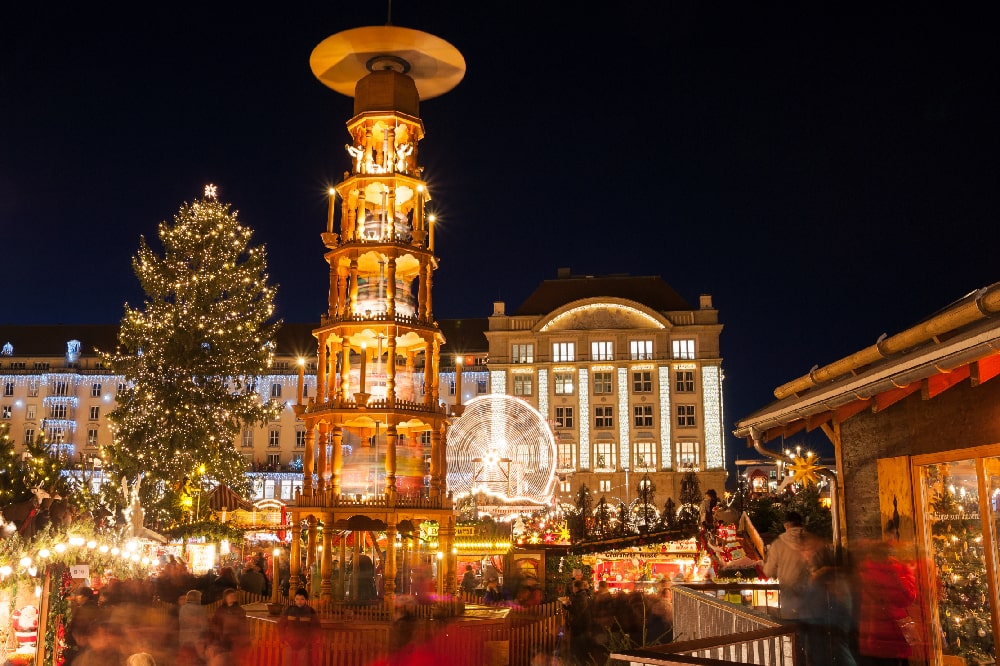
A Christmas pyramid consists of several tiers arranged one above the other, on which candles or small lights are placed. By heating the air, these set a propeller at the top of the pyramid in motion, causing the wood-carved figures to rotate.
The figures decorating the German Christmas pyramid are small characters depicting Nativity scenes, creatures from folklore or simply objects associated with Christmas. The pyramid is also often decorated with plants traditionally associated with good luck, such as mistletoe or butcher’s broom, paper garlands and biscuits shaped like hearts or stars.
Discover traditional Christmas pyramids and candle arches, typical Christmas decorations from Northern Europe.
Christmas pyramids are very popular in Germany, particularly in the Ore Mountains region, where numerous Christmas markets dedicated to this tradition can be visited. However, they can also be found in other European countries and beyond. Originally, they were hung from the ceiling.
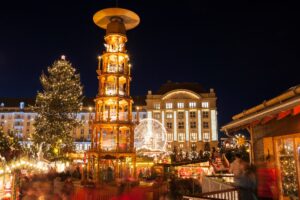
In Dresden, the Striezelmarkt, Germany’s oldest Christmas market, takes place every year. Among its most spectacular attractions are its impressive wooden Christmas decorations, including the world’s tallest Christmas pyramid, standing 14.61 metres high, and a gigantic candle arch, both symbols of the region’s traditional craftsmanship. Naturally, the Dresden pyramid moves too!
The predecessor of the Christmas tree
The Christmas pyramid undoubtedly influenced the evolution of Christmas decorations and can be considered an ancestor of the Christmas tree. However, the two traditions developed distinctive characteristics over time, becoming meaningful symbols in their own right. They certainly share similar origins, associated with the ancient custom of decorating trees on particular occasions.
The tree, a symbol of life in many cultures, plays a central role in numerous mythologies and pagan rituals. The Druids, for example, saw evergreens as a symbol of eternal life because they remained green even during winter. During their celebrations, they decorated or burned branches from these trees as ritual offerings. With the advent of Christianity, these ancient rites merged with new religious beliefs. During the Middle Ages, celebrations centred around trees, inspired by the expulsion of Adam and Eve from Eden, began to spread through the town squares of northern Europe. The tree of Eden, initially a symbol of original sin, gradually became associated with Jesus’ sacrifice and the salvation of humanity, with the Cross compared to a tree that brings hope and redemption. Over time, large trees were erected in the squares of European villages during the Christmas season and decorated with dried fruit, apples and paper decorations. Branches were also brought inside homes and decorated with paper flowers, sweets and small objects. Initially, fruit trees were used because of their association with abundance, but gradually the fir tree, particularly cherished in German tradition, became the preferred choice. The custom of decorating fir trees spread throughout the rest of Europe and the Catholic world, with fruit and paper flowers eventually being replaced by garlands, ribbons, candles and, later, delicate blown-glass ornaments.
Hand-painted Christmas tree decorations made from blown glass.
It is not entirely correct to think of the Christmas pyramid as the predecessor of the Christmas tree. It is true, however, that both traditions have their roots in pre-Christian customs associated with the veneration of evergreen trees, which were regarded as symbols of eternal life.
We can also say that Christmas pyramids, which originated in the 18th century, preceded the widespread adoption of the Christmas tree in its present-day form. In fact, from the 17th century onwards, with the introduction of Christmas trees into aristocratic homes, a process of popularisation began that eventually led to the form we know today. It is no coincidence that Germany, already the home of Christmas pyramids, is believed to have been one of the first countries where the Christmas tree became widespread in its modern form. The custom then gradually spread to other parts of Europe, including Alsace, France and Italy. With the invention of electric lights at the end of the 19th century, the Christmas tree became firmly established as one of the most recognisable symbols of Christmas.
There are, however, some important differences. First of all, as well as being a decoration, the Christmas pyramid is an object that produces movement through the heat generated by candles. The Christmas tree, on the other hand, is primarily a structure on which decorations are hung.
A full, detailed Christmas tree, perfect for decorating your home during the festive season.
Christmas pyramids on Holyart
In our online store, you can also find small and exquisite Christmas pyramids made from handcrafted wood according to the ancient traditions of Val Gardena, such as the colourful Val Gardena maple wood Christmas pyramid with Kaledos Nativity. The colourful Kaledos pyramid is a refined example of traditional craftsmanship. The composition includes figures of Mary, St Joseph, Baby Jesus and a sheep, all positioned on a circular wooden base. This base rests on another wooden structure. The scene is framed by a wooden arch supporting a propeller at the top. The movement of the propeller, activated by the heat of four candles positioned symmetrically around the circumference of the larger base, causes the upper platform to rotate, creating a captivating and dynamic scene.
The small Christmas pyramid without candles, whether wax or electric, also moves thanks to rising warm air. This model also depicts the Holy Family, with Baby Jesus in the manger, St Joseph standing with his staff and Mary in adoration. The pyramid can be placed on a radiator or windowsill, where the heat from the heating system will set it in motion, with its speed increasing as the heat intensifies.
Christmas pyramid made from Val Gardena maple wood with a colourful Kaledos Nativity scene, featuring 8 cm tall figures. Shop now at Holyart
Small Christmas pyramid without wax candles or electric lights, which rotates thanks to rising warm air. Shop now at Holyart
Christmas pyramid with Luna angels, made from natural Val Gardena wood. Shop now at Holyart
Christmas pyramid featuring the Holy Family and a sheep, with 7 cm tall figures from the Aram collection, made from natural and two-tone patinated wood, with LED lighting. Handcrafted in Val Gardena. Shop now at Holyart
The Vatican IOR is a financial institution established to safeguard and administer the movable and immovable assets of the Church...
28 October 2026
What’s the Future of Religion?
What’s the Future of Religion?
A Beginner’s Guide to Christianity
A Beginner’s Guide to Christianity
Mind-Blowing Statistics About Christianity You Need to Know
Mind-Blowing Statistics About Christianity You Need to Know
9625
Enter the Holyart world: $20 discount voucher valid on over 60,000 items
Come and discover Holyart, the largest e-commerce of religious articles in Europe and immediately receive a $20 voucher to use with your first purchase.
Check your mailbox: you will receive your discount within 5 minutes