Every year, on 21 November, Venetians gather to honour Our Lady of Health, an event that combines religious devotion, tradition and a profound sense of historical gratitude
Contents
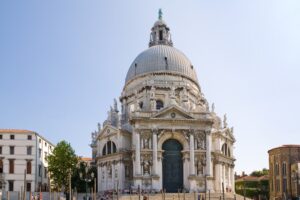
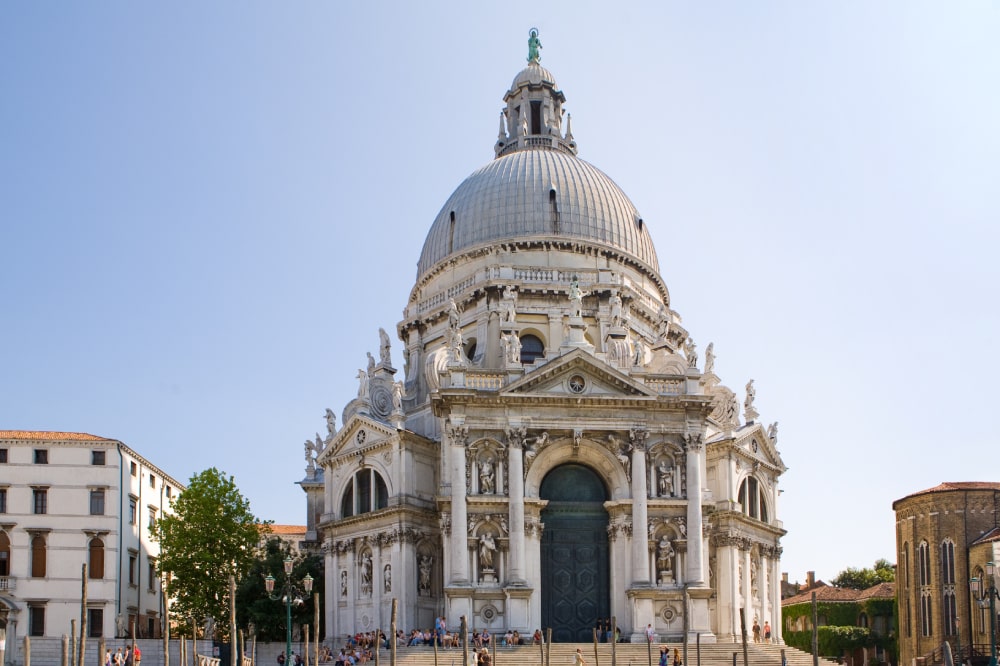
On 21 November, the day commemorating the Presentation of Mary at the Temple, the Feast of Our Lady of Health is celebrated in Venice, Trieste and other cities and territories of Italy, Istria and Dalmatia. This celebration, which blends religious devotion, tradition and popular culture, has its origins in the distant 17th century, and represents a moment of thanksgiving and prayer for the health of the population, following the end of a terrible plague. In 1630, when a devastating epidemic of bubonic plague struck Venice, causing thousands of deaths, Doge Nicolò Contarini and the Senate of the Republic of Venice, in despair, decided to turn to Our Lady to ask for her intercession. In return for her help, they promised to build a great votive church, if the city were freed from the plague. The prayer was heard, and in 1631 the epidemic came to an end. To keep the promise made to Our Lady, the Basilica of Santa Maria della Salute was built, designed by the architect Baldassare Longhena. Its majestic dome is today one of the most recognisable symbols for those who visit Venice.
https://www.holyart.com/blog/religious-items/marian-feasts-here-are-all-the-annual-celebrations-dedicated-to-mary/
Marian Feasts, All the Faces of Devotion to Mary, Mother of Jesus
Basilica of Santa Maria della Salute
The Basilica of Our Lady of Health, also known as the Church of the Salute, or simply La Salute, can be seen from many of the most characteristic places in Venice, from the Accademia Bridge, from the beginning of the Grand Canal in the San Marco area. It is located in the Dorsoduro sestiere, one of the largest in Venice, which also includes the island of Giudecca and is the heart of the city’s student life. The basilica was built on the Punta della Dogana, also known as Punta della Salute or Punta da Màr, an area of Venice characterised by a slender triangular point that separates the Grand Canal from the Giudecca Canal, overlooking the Bacino di San Marco. The foundation stone was laid on 28 November 1631 and the church was completed in 1687.
The external structure is imposing. 15 modillions, cornices in Istrian stone shaped like spirals with concentric circles, support the upper cornices, which house statues of saints. Between the interior and exterior, the church boasts around 150 statues depicting prophets, apostles, saints, the four evangelists, sibyls, Doctors of the Church and other figures from the Old Testament. Monumental is the hemispherical dome, formed by octagonal sails covered with lead slabs, and culminating in a lantern surrounded by eight pointed obelisks projecting towards the sky, itself surmounted by the statue of Our Lady Capitana da Mar. All these architectural elements contribute to creating an illusion of upward thrust.
Inside, the basilica appears very spacious, with its circular base covered by the magnificent mosaic floor of polychrome marble. 32 concentric circles enclose the central circle, where the phrase unde origo, inde salus, “only from the origin comes salvation”, is engraved, where by ‘origin’ is meant both the church itself, the pledge offered in exchange for the salvation of the city, and the Virgin, mother of Jesus, and therefore the origin of salvation and eternal life.
On the high altar, a sculptural group represents Venice freed from the plague: the Virgin with the Child in her arms and 3 cherubs at her feet watches as an angel drives away the plague, in the form of a gaunt old man, threatening it with a lit torch. A female figure, representing Venice, looks towards Our Lady in an attitude of supplication and adoration. Also worthy of admiration is the Byzantine icon of the “Madonna della Salute” or “Mesopanditissa”, or, using other Marian titles, Our Lady of Grace, Mediatrix of Peace. Brought to Venice as a trophy at the end of the War of Candia against the Turks, she is an Odighitria Madonna, “She Who Shows the Way”.
Feast of Our Lady of Health
Every year, on 21 November, thousands of Venetians and tourists go to the Basilica della Salute, which on this occasion remains open without interruption, to thank Our Lady and ask for protection for personal and collective health. Celebrations, Masses and rosaries are held inside the Basilica throughout the day. A temporary floating bridge is erected over the Grand Canal, connecting Santa Maria del Giglio to the Basilica, thus facilitating the influx of pilgrims. For Venetians, 21 November is a day of patronal celebration, no less important than 25 April, when Saint Mark, Patron Saint of Venice, is celebrated. Among the traditions of the Feast of the Salute, since the 1600s there has been the custom of eating Castradina, a typical dish made with a salted and smoked leg of mutton, immersed in a rich soup of savoy cabbage, onions and wine, which dates back to the time of the plague, when food resources were scarce.
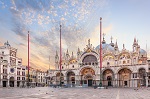
Saint Mark the Evangelist: the disciple of Saints Peter and Paul
Saint Mark the Evangelist, patron saint of Venice, was a missionary with Saint Paul and a disciple of Saint Peter.
The feast is not only a religious event, but also an important manifestation of Venetian popular culture. Near the basilica there is a fair with stalls selling sweets, toys, and typical products. Less grandiose than the Feast of the Redeemer, celebrated every year on the third weekend of July, the Feast of Our Lady of Health is more intimate, but also more Venetian, more deeply felt by the local population, both on a devotional and on a popular level.
Prayer to Our Lady of Health
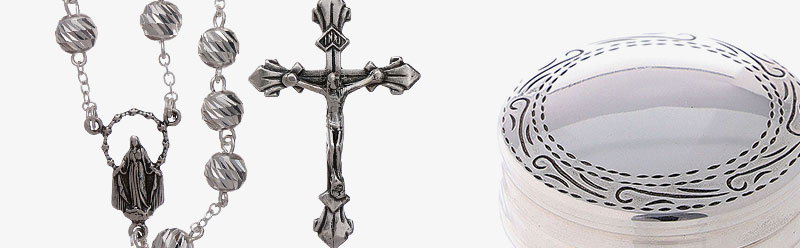
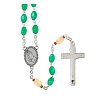
Here is a prayer of entrustment to Mary, Our Lady of Health, written by the Patriarch of Venice Francesco Moraglia. And to pray to Our Lady of Health, you can use the dedicated Rosary of Our Lady of Health, made in Italy, in metal, with white and green beads. The rosary is equipped with a delicate crucifix and a centrepiece depicting Our Lady of Health on the front and praying hands on the back. Together with the rosary, booklets in Italian, Spanish and English are provided explaining how and when to pray the Rosary of Our Lady of Health, with the history and associated prayers.
Our Lady of Health,
Powerful Virgin,
Most loving Mother,
as Your children we return to You,
to You we turn
to entrust ourselves to Your maternal protection.
We remember the many benefits
that You have never failed to grant to those who,
with faith, love and a contrite heart,
have invoked You as their Mother.
Help us once again,
manifest Your supplicating omnipotence
and ask from Jesus Your Son,
our Most Holy Redeemer,
health, salvation and peace
for all His people.
Our Lady of Health,
we consecrate to Your Immaculate Heart
the city of Venice and our Venetian lands.