Homepage | Religion | Saint Mark the Evangelist: the disciple of Saints Peter and Paul
Saint Mark the Evangelist: the disciple of Saints Peter and Paul
15 April 2026
Reading Time: 6minutes
Saint Mark the Evangelist, patron saint of Venice, was a missionary with Saint Paul and a disciple of Saint Peter. He founded the Coptic Church in Egypt and wrote the first of the four canonical Gospels. Here is his story.
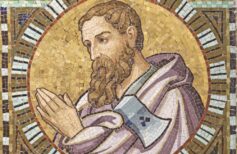
We do not know much about Saint Mark the Evangelist, who was a disciple of Saint Paul, and whom Saint Peter called his “son”. The two saints mention him, and brief passages about him can be read in the Acts of the Apostles and in some apocryphal documents. Yet his importance is undeniable, considering that his Gospel is one of the four canonical Gospelsof the Christian religion, used as the primary source by Matthew and Luke for their respective Gospels. Written in Greek, probably in Rome around 70 AD, the Gospel of Mark is in fact the oldest among the Gospels, and also the shortest. It consists of 16 chapters and focuses in particular on the mission of Jesus, described as the Son of God, exorcist, healer, man of action, and on the difficulty the discipleshad in understanding His preaching, especially the parables and miracles. Mark’s account begins with the Baptism of Jesus by John the Baptist and focuses above all on the last week of His life. The numerous explanations attributed to Jesus Himself and the linguistic clarifications suggest that the text was written for non-Jewish readers.
Since the Gospel of Mark is anonymous, its attribution to the disciple of Peter and Paul has always been the subject of study and debate.
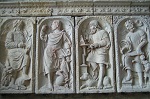
The statuettes reproduce the scene from the life of Jesus in which he receives baptism from John the Baptist.
When is Saint Mark the Evangelist celebrated? The Church celebrates the liturgical memorial of Saint Mark on 25 April, the date of his probable martyrdom in Alexandria, Egypt. On that occasion in Venice, one of the main cities of which the Saint is patron, a solemn procession takes place in the Basilica dedicated to him, recalling the most sumptuous processions of antiquity, in which all the religious and civil authorities and representatives of the city’s guilds took part.
Venerated by the Catholic, Orthodox and Coptic Churches, of which he is patriarch, Saint Mark the Evangelist is the patron saint of notaries, scribes, glassmakers and opticians.
Little is known about the life of Saint Mark the Evangelist, beyond what was written about him by Peter and Paul and in the Acts of the Apostles. It seems that he was the son of Mary, the widow who owned the house near the Garden of Olives, which hosted Jesus and the Apostles during the Last Supper. According to some traditions, Mark himself was the young man who followed Jesus as He was taken away, wearing only a linen cloth. A Jew of Levitical descent, we do not know what work Saint Mark did before becoming a missionary and then the author of the first Gospel. Mark was his Gentile name, while his Jewish name was John, by which he is referred to in other passages of the Acts. He is also mentioned as the cousin of Barnabas, the name given to Joseph of Cyprus, a preaching companion of Saint Paul, first in Antioch and then on the island of Cyprus, then known as Salamis, where the two cousins are said to have preached together with Paul on his first missionary journey. Mark then returned to Jerusalem, but continued to follow Paul on other journeys, as attested by the words of the Apostle to the Gentiles himself in a letter to his companion Timothy: “Do your best to come to me quickly… Only Luke is with me. Get Mark and bring him with you, because he is helpful to me in my ministry” (Timothy 4:9–11).
Saint Mark was also bound by a close friendship with Saint Peter, who wrote of him in his first letter: “She who is in Babylon, chosen together with you, sends you her greetings, and so does my son Mark.” Saint Mark was probably at Peter’s side in Rome, and may have received Baptism from him. His connection with the apostles Paul and Peter recurs repeatedly in all documents concerning him. After the death of both, Saint Mark evangelised Egypt and founded the Church of Alexandria, becoming its first bishop.
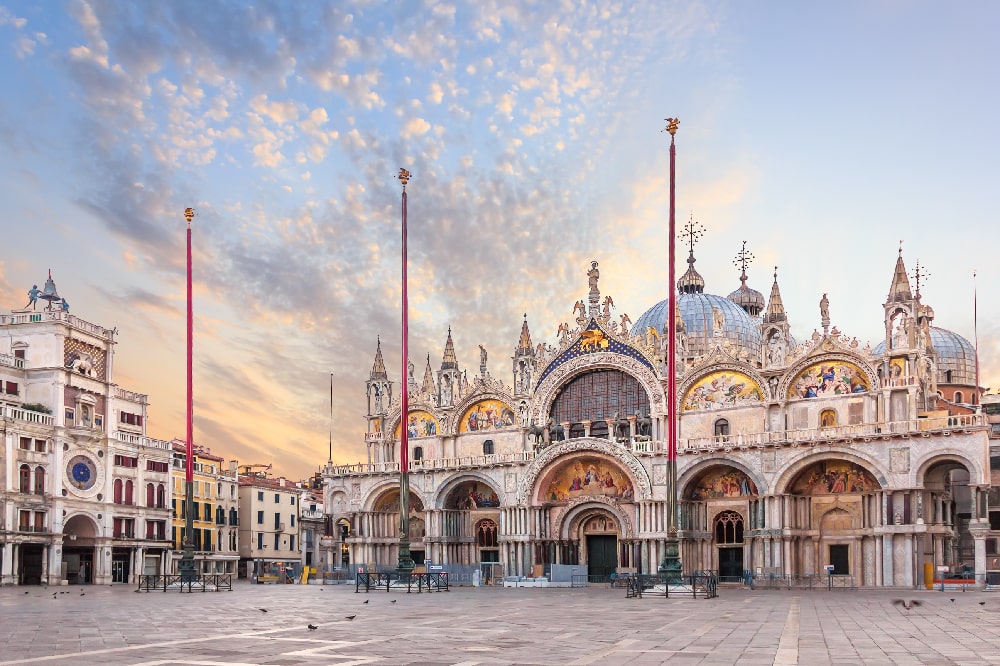
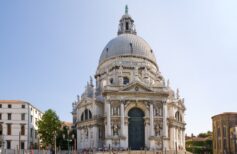
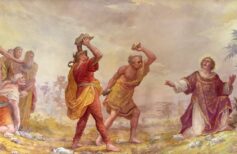
How did Saint Mark the Evangelist die? There is no certain information regarding his death. According to the Golden Legend and other chroniclers, he was martyred in Alexandria, Egypt: his body was dragged through the city several times. His remains were hidden in Alexandria, saved from the flames by his disciples, and here in the year 828 two Venetian merchants are said to have found them and brought them to Venice in a basket of pork and vegetables. The lagoon city immediately welcomed the Saint, dedicating several churches to him over the centuries, culminating in the magnificent Basilica we all know: Saint Mark’s Basilica, the cathedral of Venice famous throughout the world.
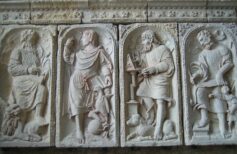
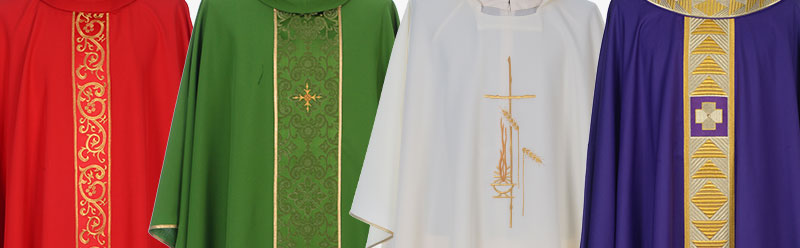
The priest stole comes in ivory with Saint Mark the Evangelist holding a book, on the opposite side, there is winged lion.
The symbol of the Evangelist Mark
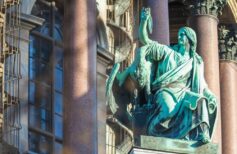
In the tetramorph, the iconographic representation composed of the four symbols of the four evangelists, Saint Mark is represented by a winged lion, and with this symbol he has always appeared in iconography and in the history of art. We recall that the symbols of the other evangelists are: a winged man for the Gospel of Matthew, a bull or calf for that of Luke, and an eagle for the Gospel of John.
The Lion of Saint Mark, or the Lion of Saint Mark, is often depicted with a halo on its head and a book between its paws, and in this form it has for centuries been the symbol of the city of Venice. On the book is inscribed: “Pax tibi Marce evangelista meus”, part of the phrase that, according to a very ancient tradition, an angel in the form of a winged lion addressed to Mark, who had landed by chance in the Venetian lagoon, foretelling the place where his remains would one day rest: “Pax tibi Marce, evangelista meus. Hic requiescet corpus tuum.” (Peace be with you, Mark, my evangelist. Here your body shall rest.)
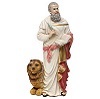
Richly detailed statue in resin, hand-painted. Compared to PVC, resin statues have more definition in the lines and design.
The patron saint of Venice
Many are the traditions that Venice has dedicated to Saint Mark the Evangelist over the centuries. One particularly romantic custom holds that on 25 April, the day of his liturgical memorial, lovers give a “bocolo”, a bud of red rose, to the woman they love. A legend tells the troubled love story between Maria, daughter of Doge Orso Partecipazio, called “Vulcana” for the intensity of her gaze, and Tancredi, a storyteller. Maria persuaded Tancredi to set out with the paladins of Charlemagne to prove his worth to her father the Doge, and he covered himself in glory, like Orlando and Rinaldo. When the paladins returned to Venice, however, Vulcana searched for him in vain among them: Tancredi had died in battle, betrayed by his own ardour. One of his companions gave her a red rose stained with his blood. Vulcana shut herself in her room with the rose, and there she was found dead, beside the bud, which had become fresh again as if just picked.
Despite their diversity, many religions show elements in common. Let us discover which religions believe in angels Angels are perhaps...
5 October 2026
What’s the Future of Religion?
What’s the Future of Religion?
A Beginner’s Guide to Christianity
A Beginner’s Guide to Christianity
Mind-Blowing Statistics About Christianity You Need to Know
Mind-Blowing Statistics About Christianity You Need to Know
9026
Enter the Holyart world: $20 discount voucher valid on over 60,000 items
Come and discover Holyart, the largest e-commerce of religious articles in Europe and immediately receive a $20 voucher to use with your first purchase.
Check your mailbox: you will receive your discount within 5 minutes