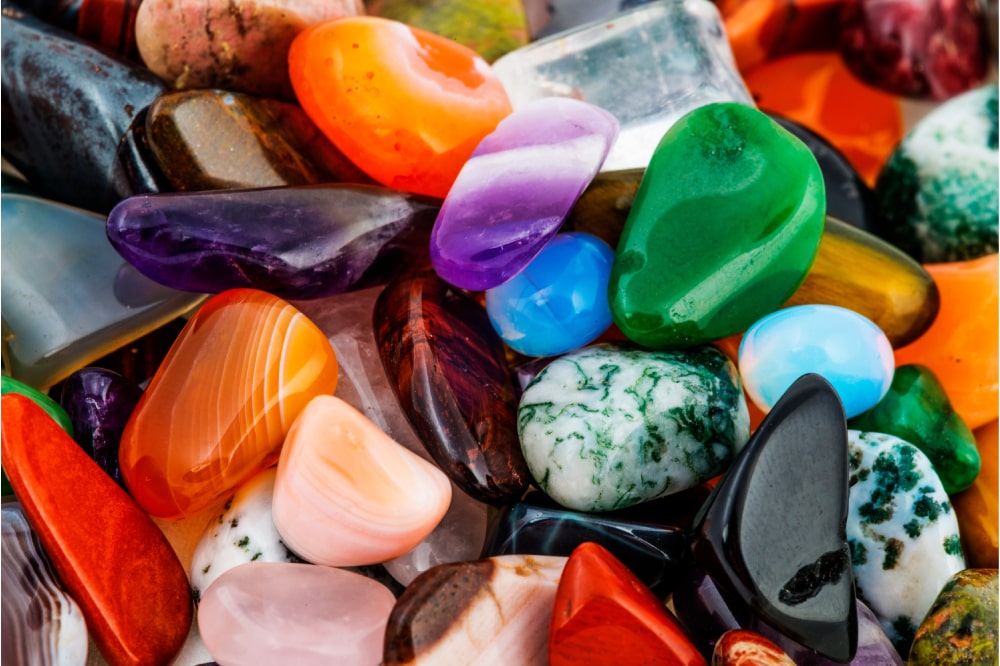
Precious or semi-precious, natural hardstones have always represented a valuable resource for the manufacture of ornaments and jewellery. But some also have a deep symbolic meaning.
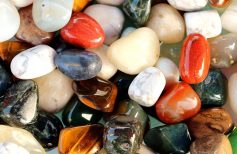
There are many different types of natural hardstones. Sometimes they are varieties of minerals or rocks or crystals, or materials of animal origin, such as ivory, coral and pearls, or of plant origin, such as amber and jet. Diamonds, rubies, sapphires and emeralds, the four most prized and valuable gemstones, are natural mineral crystals; opals are monomineralic aggregates. What all these stones have in common is the fact that they can be cut, polished and worked to enhance their value and beauty. It is precisely their lustre, colour and transparency that make precious stones and natural hardstones collectible items, as well as valuable ornaments for creating jewellery or for ornamental or decorative purposes.
We have already seen how natural hardstones can be distinguished according to their origin: mineral, plant or animal. But there are other classification criteria, which define, for example, whether a stone is precious or semi-precious, whether it is a gem or a hardstone. The defining criteria are the rarity, origin and quality of the stones. Even the ancient Greeks distinguished between precious and semi-precious stones, based on rarity, lustre and hardness. Today we still consider the same gems to be precious stones, such as diamond, ruby, sapphire and emerald, but it can happen that particular varieties of stones considered semi-precious exceed the value of true gems. For this reason, the use today of the terms precious and semi-precious in reference to natural stones can give rise to misunderstandings. The preciousness of stones is determined by their purity, the intensity of their colour, their rarity and the way in which they are cut to enhance their unique characteristics. Therefore, it is important to consider a range of factors beyond traditional classification in order to assess the true value and appeal of a stone. Precious gems or precious stones will therefore be those that are most beautiful, pure, transparent and luminous, such as the aforementioned diamonds, rubies, sapphires and emeralds, but also amber, pearls, coral, ivory, mother-of-pearl and carnelian.
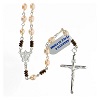
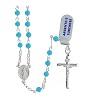
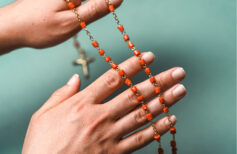
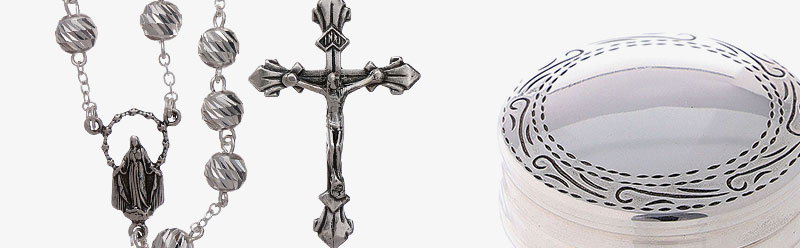
Rosary with mother-of-pearls grains and trefoil cross.
As regards the so-called hardstones, in the past this definition included certain qualities of marble, porphyry and granite. Stones used to create inlays and mosaics were also called hardstones: jasper, onyx, agate and moonstone. In general, the concept of hardstone was associated with opaque or non-transparent materials. Today these stones tend to be considered semi-precious, but once again it is necessary to measure their degree of lustre, workmanship and rarity. There may be turquoises and amethysts that are more valuable than so-called true gems. Jade and opals are also used for high jewellery creations. There are hardstone necklaces, as well as rings and bracelets, that can be worth much more than those adorned with precious gems. The hardness of stones is defined by the Mohs scale, named after its inventor, the German mineralogist Friedrich Mohs (1773–1839).
Rosaries with precious hardstones beads such as Malachite, Aventurine quartz, Hematite, Amethyst, Pink Quartz and Lapislazuli.
Also in the religious sphere we find extensive use of precious stones and hardstones. In addition to the aforementioned mosaics, present in many churches, in the past it was common for sacred furnishings and liturgical objects, such as chalices, ciboria, patens and monstrances, to be richly adorned with inlays and precious stones. According to the Bible, the breastplate of the ephod, a garment worn by the High Priest Aaron, brother of Moses, was adorned with twelve precious stones, each representing one of the twelve tribes of Israel, divided into four rows of stones: in the first row a sardonyx, a topaz, an emerald; in the second row, a ruby, a sapphire, a chalcedony; in the third row, an opal, an agate, an amethyst; in the fourth row, a chrysolite, an onyx and a jasper.
In this category you’l find more than 300 precious items handcrafted by italian artisans.
The rings worn by Bishops, ArchbishopsandCardinals are still decorated with gems, which not only define the clerical hierarchy but also express a deep symbolic meaning. For example, the choice of amethyst as the gem to decorate a Bishop’s ringhas ancient and symbolic roots. This stone is mentioned in the Bible among the ceremonial vestments intended for Aaron, according to God’s instructions to Moses, and it was chosen for the Bishop’s ring mainly for its colour, purple, which has a sacred meaning. Purpleevokes the concept of penance, expectation and mourning, but also the mystical marriage between Jesus and His Church. This colour is particularly significant during liturgical periods such as Advent and Lent, which emphasise the profound spiritual meaning of the ring and its gem. Topaz, a marvellous stone with golden reflections, instead adorns the ring of Archbishops. It too is mentioned in the Bible among the sacred gems intended to adorn the breastplate of the High Priests, associated with the twelve tribes of Israel and the twelve angels who guarded the Ark of the Covenant and presided over the gate of Paradise. Cardinals, finally, are invested with a ring given to them by the Pope during a secret consistory, symbolising their dignity and their alliance with the Church. This ring may be adorned with a sapphire, a gemstone long associated with the divine, or with a ruby, defined as the “king of precious stones”, once the quintessential wedding ring.
Let us look at a list of some precious stones and natural hardstones and their uses and meanings.
Aquamarine
Aquamarineis a light blue crystal, long associated with serenity and joy, and considered the stone of eternal youth. It promotes emotional balance and is attributed with healing, purifying and regenerating properties.
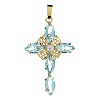
Pendant cross with aquamarine shuttles iset by hand on free light gold brass bezels, made by an Italian company.
Amethyst
This purple hardstone is associated with protection, purification and wisdom. It is often used to promote calm and mental clarity. According to crystal healing, amethystis associated with balance, self-control, self-esteem and the enhancement of positive dreams, while it repels nightmares.
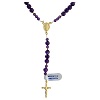
Rosary with cross and medal in 925 silver with golden finish, amethyst beads and golden faceted hematite washers.
Coral
Since ancient times coral has been attributed with special meanings and properties. Coral is an exoskeleton formed by small polyps which, in order to protect and support their soft bodies, secrete calcium and form branches of calcium carbonate. These secretions layer over time, allowing coral to merge with other formations and giving rise to extensive coral reefs. Considered for centuries a powerful remedy against diseases and epidemics, coral has also been associated with fertility and protection against misfortune, as evidenced by the still-living tradition of coral lucky charms in Naples. In Christian symbolism, coral has been linked to the Passion of Christ and His blood, and used to decorate reliquaries and sacred paintings.
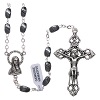
Hematiteis generally a grey-black stone, but can vary from darker to lighter shades. When cut and polished, it can show a silvery metallic reflection. It is one of the harder stones, with a hardness ranging between 5.5 and 6.5 on the Mohs scale. Composed mainly of iron oxide, it becomes magnetic when subjected to an external magnetic field. Used in jewellery and as an ornamental stone, it is associated with strength and protection.
Rosary with hematite grains and trefoil cross with 6×3 mm grains.
Garnet
Garnet is a gemstone known for its unique characteristics and deep symbolism. With its intense red hue reminiscent of the colour of blood, garnet has always been associated with strength, passion and vitality. Symbolically, garnet represents inner strength and determination. It is considered a protective talisman, capable of repelling negative energies and instilling courage in those who wear it. This gemstone is often associated with rebirth and renewal, as it was believed to help overcome challenges and emerge stronger and more resilient. In history and culture, garnet has been admired and appreciated in many ancient civilisations. The ancient Egyptians, for example, considered it a sacred stone and used it as a protective amulet. Moreover, garnet was often used in royal and noble jewellery as a symbol of power and prestige.
Lapis Lazuli
A deep blue hardstone with inclusions of golden pyrite, it is associated with truth, wisdom and communication. It has historically been used as a symbol of power and nobility. A stone of friendship and harmony between mind and heart, lapis lazuli is associated with Saint Michael the Archangel, bearer of protection and spiritual guidance. It stimulates creativity and clarity in communication.
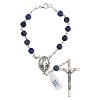
Single decade rosary with round beads of 6 mm made of real lapis lazuli and Miraculous Medal.
Malachite
Deep green in colour with wavy bands, malachiteis associated with emotional and spiritual healing. It is known for promoting personal growth and transformation. Sacred to Aphrodite, the goddess of beauty, in many cultures malachite has been revered as a symbol of the feminine divine, an expression of seduction, sensuality, aesthetic sense and love of beauty and the arts. This crystal, with its deep and enveloping green, encourages luck in love and promotes trust in friendships.
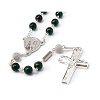
Precious rosary of rhodium-plated 925 silver with 6 mm malachite beads and Our Father beads of rhodium-plated silver with diamond effect.
St Lucy’s Eye
St Lucy’s Eye is a shell operculum, specifically produced by the mollusc *Bolma rugosa*. This particular operculum, commonly found on beaches, is symbolically considered the eyes of Saint Lucy, a Christian martyr and patron saint of Syracuse. Saint Lucy was a young woman of noble origins born in Syracuse in the 4th century AD, who lived during the period of Christian persecutions in the Roman Empire. One of the most widespread legends concerns the miraculous healing of Saint Lucy’s mother. It is said that Lucy’s mother was suffering from a serious illness and that Lucy, praying fervently, obtained the miracle of her healing through the intercession of the Virgin Mary. As a gesture of gratitude, Lucy decided to consecrate her life to God and devote herself entirely to her faith. To defend her purity and avoid the suitors who sought to marry her, Lucy is said to have torn out her eyes and thrown them into the sea. However, later, the Virgin Mary restored Lucy’s sight and gave her eyes even more beautiful and luminous than before, symbolised by the shell operculum known as “St Lucy’s Eye”.
Tiger’s Eye
Tiger’s Eye typically features a combination of brown, yellow and golden-bronze tones, reminiscent of a tiger’s eye. Hard and resistant enough to be used in jewellery to create necklaces, bracelets, earrings and other ornaments, it is often associated with protection, strength and determination. It is believed to help promote mental clarity, protect against negative energy and encourage a connection with the energy of the earth.
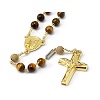
Rosary made of 5 decades of tiger’s eye beads of 6 mm and Our Father beads of gold-plated 925 silver with diamond finish with the same diameter.
Onyx
Onyxis a gemstone known for its beauty and metaphysical properties. Traditionally black in colour, it can also display white, grey or brown bands. These bands may be parallel or wavy, creating a unique aesthetic effect. Onyx is considered a protective stone that helps repel negative energies and create an energetic shield around the person who wears it. It is believed to absorb and transform negative energies into positive energy. Used for centuries in jewellery, sculpture and art objects, it is still used today for necklaces, bracelets and hardstone rings.
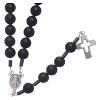
The beads of the rosary are in satinized onyx sized 8 mm and small cylinders in grey satinized hematite sized 5×3 mm used as separators.
Pearl
Pearls are unique and fascinating jewels, appreciated for their natural beauty and variety of characteristics. Their variety of colours, shapes and sizes makes them suitable for a wide range of jewellery and accessories. Pearls are produced by molluscs such as oysters, which form them as a defence mechanism in response to the intrusion of foreign bodies within their mantle. They are composed mainly of calcium carbonate, deposited in concentric layers around the intruding nucleus, and can display a wide range of colours, including white, cream, pink, silver, gold, black, green, blue and purple. Pearls can also take various shapes, including round, oval, baroque (irregular) and semi-baroque (almost round). One of the most desirable characteristics of pearls is their lustre, that is, the brightness and reflectivity of their surface. Pearls with strong lustre are considered to be of high quality. Pearls may be of natural origin, formed spontaneously in the mollusc’s mantle, in the sea or in rivers, or cultured, produced artificially by introducing a nucleus into the mollusc and stimulating pearl formation. Natural pearls are generally rarer and more expensive than cultured pearls.
Rosary in 925 silver with 6 mm rose hematite beads.Rosary made in Italy with 925 silver.
Moonstone
Moonstone is a mineral associated with the Moon and long linked to feminine energies. It has been used as an amulet and lucky charm in many Eastern cultures and is associated with the Archangel Gabriel, for its purifying energy and to ask for his blessing for all newborns (Gabriel is the guardian of birth).
Lava Stone
Lava stone is a volcanic rock formed by the hardening of magma that emerges during volcanic eruptions. Composed mainly of silicates and minerals, it has a dark colour ranging from black to dark grey, with a surface that is often porous and irregular. Its structure may contain air bubbles or inclusions of other materials, giving it a unique appearance. It has historically been used for a wide range of practical and decorative purposes, and in the production of handcrafted objects such as sculptures, artefacts and jewellery.
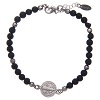
Saint Benedict men’s bracelet with lava stone beads. Silver bracelet with Saint Benedict medal measuring 1cm diameter.
Rose Quartz
Rose quartz is a gemstone with a delicate appearance and powerful metaphysical properties. Pale pink in colour, which can range from light to more intense shades, it is often transparent but can also be opaque. Its delicate pink tone makes it highly valued in jewellery. Commonly associated with love in all its forms, it is believed to promote romantic love, self-love, family love and universal love. It is considered a powerful crystal for emotional healing and for opening oneself to forgiveness and compassion.
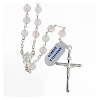
The rosary is made of 925 silver by Italian artisans from a company with thirty years of history in the manufacture of silver and that takes care of its items in every detail.
Turquoise
Used for thousands of years in the manufacture of jewellery, particularly hardstone bracelets, turquoiseis a blue-green hardstone associated with protection and healing. It is often used to promote inner peace and tranquillity and offers a wide range of spiritual, emotional and physical benefits. It can be a valuable ally for those seeking balance, protection and personal growth.
Rosary of 925 silver with 0.016 in turquoise beads. Precious rosary of 925 silver with round beads of turquoise of 0.016 inches of diameter
Topaz
Used to adorn the rings of Archbishops, for the ancient Egyptians topaz represented the stone of Ra, the Sun God, and its name in ancient Sanskrit means “fire”. Its brown and golden colour evokes the sun, the earth, fertility and life itself. The Greeks believed it bestowed physical and mental strength, attributing particular importance to it from both a spiritual and physical point of view.
On 28 October the Church celebrates the joint liturgical memorial of Saint Simon the Zealot and Saint Jude Thaddeus. Here...
14 September 2026
What’s the Future of Religion?
What’s the Future of Religion?
A Beginner’s Guide to Christianity
A Beginner’s Guide to Christianity
Mind-Blowing Statistics About Christianity You Need to Know
Mind-Blowing Statistics About Christianity You Need to Know
9093
Enter the Holyart world: $20 discount voucher valid on over 60,000 items
Come and discover Holyart, the largest e-commerce of religious articles in Europe and immediately receive a $20 voucher to use with your first purchase.
Check your mailbox: you will receive your discount within 5 minutes