The History of Saint Florian of Lorch, the Patron Saint of Firefighters
4 May 2026
Reading Time: 4minutes
Saint Florian of Lorch is a much-loved saint in Austria and the neighbouring regions. The protector of firefighters, in life he was a Roman veteran who converted to Christianity.
The liturgical memorial of Saint Florian of Lorch is celebrated on 4th May. He is a very popular saint in Austria, his homeland, but also in neighbouring regions such as Bavaria, the Triveneto in Italy, and Poland. In 1183, Bishop Eusebius of Modena brought some of his relics to Poland, entrusting them to Casimir II, who commissioned the construction of a magnificent church dedicated to him in Kraków.
Saint Florian is invoked to ward off fires and floods, and he is the patron saint of firefighters.
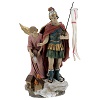
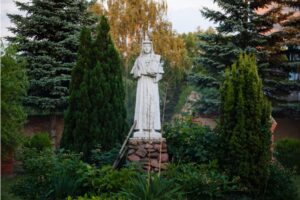
A wooden statue of Saint Florian, here depicted with a jug of water.
Who was Saint Florian?
Mentioned in a deed of gift from the 8th century AD, what we know about Saint Florian is primarily due to a passio, the Passio Sancti Floriani. This account shares many aspects with that of Saint Irenaeus, Bishop of Sirmium, who, like him, was martyredin 304 under the Emperor Diocletian.
It states that Florian lived in Mantem, near Krems, in Noricum Ripense—a region south of the Danube corresponding to modern-day Upper Austria. There he served as princeps officii (head of the provincial governor’s office) of Cetia, today Kirchdorf an der Krems, defending the northern borders and commanding a military squad trained to extinguish fires. Highly esteemed by all, Florian secretly practised the Christian religion without the knowledge of his fellow soldiers or superiors.
One day, while on duty in what is now Sankt Pölten, news reached him that forty Christians had been arrested in Lauriacum (now Lorch) by order of the governor Aquilinus, who ruled the region on behalf of Emperor Diocletian, the great persecutor of Christians.
Determined to do everything in his power to alleviate, if not prevent, the imprisonment of those men with whom he shared his faith, he set out for Lorch. However, before he could reach the city, he was intercepted by a platoon of Roman soldiers. He confessed his Christianity to them and was subsequently arrested and hauled before Governor Aquilinus.
Aquilinus initially tried to convince him to offer sacrifices to the pagan gods, as he knew the reputation of the brave veteran and did not wish to condemn him. However, Florian refused any attempt at mediation, and eventually, Aquilinus had him scourged and sentenced to death. Led to the River Anesius (Enns), Saint Florian was thrown into the water with a millstone tied around his neck. It was the 4th of May, 304 AD.
Florian died, and his body was recovered by a devout woman named Valeria and some of the faithful, and then buried. The site of his burial, over which the Bishops of Passau would later commission the great St. Florian’s Priory—one of the most famous monuments of the Austrian Baroque—immediately became a centre of devotion and worship.
Iconography of Saint Florian
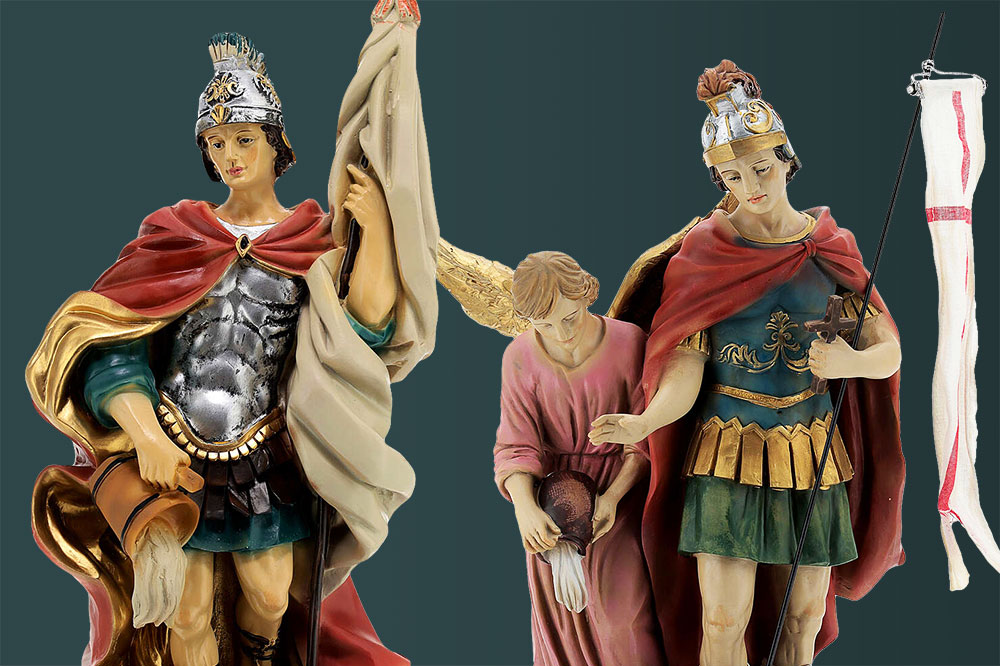
Saint Florian is often depicted with a millstone, the symbol of his martyrdom, and the martyr’s palm. He is also shown with a shield, sword, helmet, and banner to recall his life as a soldier.
In many Bavarian villages, as well as in Austria, one can find depictions of Saint Florian holding a bucket or a pitcher of water while extinguishing a fire. In many Austrian rural homes, it was once common to come across the inscription: “O Holy Florian, spare my house.”
This traditional image from Fratelli Bonella’s archives is given a sense of spirituality by the artistic effect of canvas.
The Cult of Saint Florian in Northern Italy and Austria
Because of his death in the river, Florian is considered the patron saint of flood victims and is therefore invoked during floods. His cult spread immediately after his death throughout his homeland, modern-day Austria, and neighbouring regions like Bavaria. Here, in particular, he is also regarded as the saint to invoke in the event of a fire because, according to legend, while passing through this region, Florian extinguished a terrible fire with a single bucket of water or a simple prayer. Another legend tells of two charcoal burners caught in a fire who were saved by invoking his name. He is also considered the defender of bridges.
Saint Florian is also a co-patron of Jesi, in the Marche region of Italy, which dedicates a grand festival and a famous Palio to him on 4th May. In ancient times, Saint Florian was the patron of the Respublica Aesina, formed by the Castles of Jesi. In Jesi, however, Saint Florian the Roman centurion is sometimes conflated with a namesake shepherd boy born in Cingoli who, challenged to a race by the Devil, opened the Gola della Rossa by making the sign of the cross and arrived first.
The item is made of resin, a material that allows for a higher definition of lines and details.
As mentioned, when part of Saint Florian’s relics were sent to Poland, this region also began to honour the saint with special devotion, eventually making him its patron. In Kraków, the entire university district is dedicated to the Saint’s memory, and in the basilica built by the Duke in his honour, Father Karol Wojtyła—the future Pope John Paul II—lived and worked as a curate.
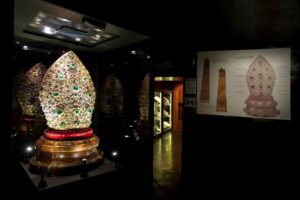
The Mitre of San Gennaro is just one of the priceless treasures that make up the treasure of Naples' patron...
2 September 2026
What’s the Future of Religion?
What’s the Future of Religion?
A Beginner’s Guide to Christianity
A Beginner’s Guide to Christianity
Mind-Blowing Statistics About Christianity You Need to Know
Mind-Blowing Statistics About Christianity You Need to Know
9117
Enter the Holyart world: $20 discount voucher valid on over 60,000 items
Come and discover Holyart, the largest e-commerce of religious articles in Europe and immediately receive a $20 voucher to use with your first purchase.
Check your mailbox: you will receive your discount within 5 minutes