Homepage | Religion | Feast of Saint Francis: the Eighth Centenary and its recognition as a national holiday in Italy
Feast of Saint Francis: the Eighth Centenary and its recognition as a national holiday in Italy
22 April 2026
Reading Time: 8minutes
In 2026, the feast of Saint Francis will coincide with the Eighth Centenary of the Saint of Assisi. On this occasion, it will once again be recognised as an Italian National Holiday.
4 October, in Italy, is not just any date. It is a day that seems to slip out of the usual rhythm, as if time itself chose to slow down, to become more attentive. The bells do not simply ring: they linger. The air carries the scent of wild flowers and incense, and in that ancient mixture a presence re-emerges that does not need to be named at once. Saint Francis, the Poor Man of Assisi, the man who knew how to walk in the world without possessing it, to touch things without harming them, to live every creature as a sister. The feast of Saint Francis of Assisi, which falls on this date, is not exhausted in a liturgy. It is a threshold, a moment in which, almost without noticing, an entire country finds itself reckoning with words that never cease to burn: peace, fraternity, care for creation. Words worn by use, perhaps, yet still capable of wounding and healing at the same time. Words which, for Francis, were not merely concepts, but lived life, choice after choice, renunciation after renunciation.
Saint Francis of Assisi: in this section you will find a rich selection of items
In 2026 this observance will take on an additional weight. The feast of Saint Francis will coincide with the Eighth Centenary of the Saint of Assisi. On this occasion, it will once again be recognised as an Italian national holiday, in the name of peace and fraternity. Eight hundred years separate that 4 October from that same night in 1226, when Francis left this earth, and yet the distance has never seemed so fragile, so fleeting. The Eighth Centenary of the death of Francis will run through Italy with celebrations, meetings, moments of reflection spread across the entire peninsula, like an invisible thread inviting people to pause, to look back not out of regret, but to find direction. The feast of Saint Francis thus becomes something more than a date on the calendar: a fixed point, a compass, a call.
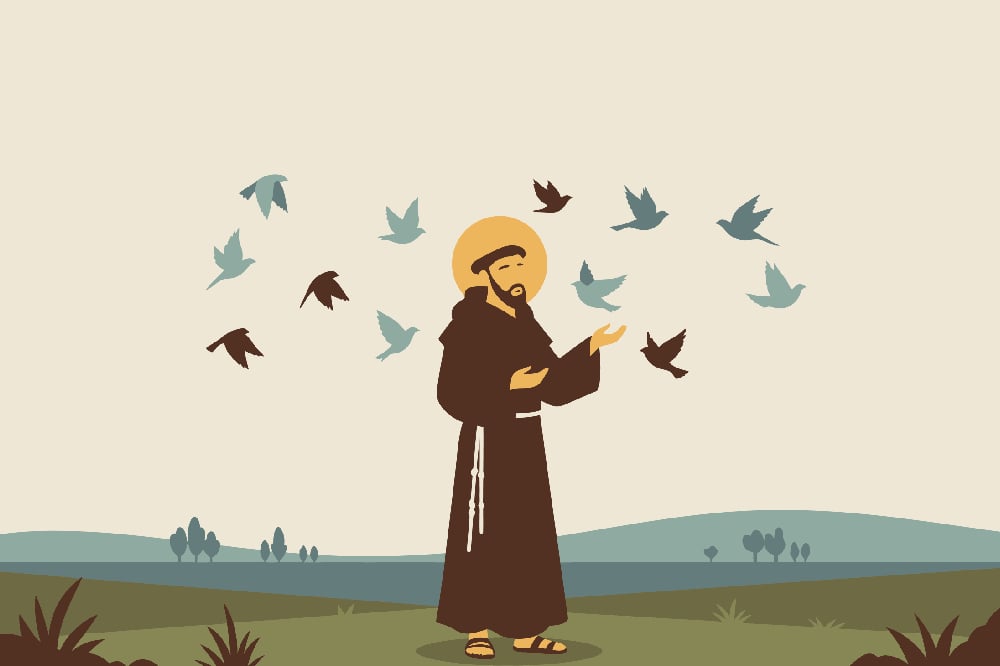
But beyond the national celebrations, personal memories remain: those that surface almost unbidden, the stories we have all heard since childhood. Francis speaking to the birds, embracing the leper, leaving everything to follow an inner voice stronger than any security. Stories perhaps heard as children, but which as adults reveal another depth. Francis was not simply “good”: he was unsettling, radical, even scandalous. A revolutionary of the spirit, capable of living the Gospel with such consistency as to seem mad to his contemporaries—and perhaps still today.
St Francis statue holds doves in his hands. Carefully detailed, made of resin.
800 years since the death of Saint Francis
Eight centuries have passed since that night of 3 October 1226, when Francis died at the Porziuncola, with his friars around him. He was only forty-four, yet his body was already exhausted: the poverty embraced to the full, the stigmata borne in silence, the illness that in his final years had made him frail, almost blind. The sources, however, speak of a serene, peaceful face. As if, in the end, there had been no fear, but only a going to meet what lay ahead.
The Eighth Centenary of the death of Saint Francis arrives in a troubled time, and perhaps that is no coincidence. We live amid environmental crises, conflicts that seem endless, ever more evident inequalities. In the midst of all this, Francis continues to speak. Not with solutions, not with slogans, but with a way of being in the world that calls into question our most deeply rooted habits. The Canticle of the Creatures, written when he was already suffering and barely able to see, is not a naïve hymn: it is the gaze of one who recognises a profound kinship with all things, even with death. A vision that today we would call ecological, but which arises from something simpler and more radical.
Francis understood that peace cannot be imposed or proclaimed. It begins within, when one stops measuring the other as an adversary or an obstacle. The prayer attributed to him—“Lord, make me an instrument of your peace”—does not console: it demands commitment. It asks one to give something up, to expose oneself, to accept change. For him, conversion was not an abstract idea, but a continuous process, often demanding, always concrete.
To look at Francis today also means questioning the future. What does it mean to live his message in the present? No habit is required, nor a withdrawal from the world. What is required is to choose what is essential, to give weight to relationships, to care for what has been entrusted to us. Francis did not speak to a chosen few: he spoke to anyone willing to listen. And perhaps this is precisely what, after eight hundred years, still makes him difficult to ignore.
From 2026, 4 October will once again be an Italian national holiday. A decision that came with a law approved in 2025, which reinstates the day of Saint Francis of Assisi among the civil holidays, with its concrete effects on work and daily life, after its abolition in 1977. It is not a folkloric return, nor a nostalgic concession. It is a choice that says something precise about what this country still recognises as essential.
Saint Francis has been the patron saint of Italy since 1939, when Pius XII proclaimed him as such together with Saint Catherine of Siena. But that title has never remained confined to an official formula. Francis runs through Italian history in a subterranean way: in landscapes, in art, in language, in a certain way of understanding poverty, beauty, and the relationship with creation. Recognising 4 October as a national holiday means giving civic form to a bond that, in fact, has never been broken.
Read more:
Santa Caterina da Siena: Patroness of Italy
Santa Caterina da Siena, from a woman of the people to an advisor to Popes and princes. Courageous, wise, and completely devoted to Christ.
This day speaks to believers and non-believers alike. Peace, dialogue, attention to the least, respect for the environment are not the words of a single tradition, but possible meeting points in a fragmented, often aggressive time. In this sense, the national holiday of Saint Francis does not divide: it gathers. It does not demand ideological adherence, but invites people to pause, at least for a day, around values that have not lost their urgency.
For Franciscan communities, naturally, 4 October remains the heart of the year. Friars, Poor Clares, and tertiaries experience it as a moment of profound renewal, a return to the origins. But Francis does not belong only to the Church. He is a figure who has spoken, and continues to speak, to different worlds, to sensitivities far removed from one another. From Giotto to Dante, from Dostoevsky to Gandhi, his passage has left traces wherever there has been someone willing to question the ultimate meaning of things.
This feast also recalls a responsibility. Italy preserves the Franciscan sites: Assisi, of course, with its basilicas and frescoes, but also a constellation of hermitages, convents, and churches scattered across the peninsula. Places that are not only artistic heritage, but living spaces, still capable today of speaking of silence, of essentiality, of peace. To celebrate them means not turning them into static relics, but keeping them open to be experienced.
Celebrations and initiatives
The Eighth Centenary of the death of Saint Francis, intertwined with the restoration of 4 October as a national holiday, has generated a broad and widespread movement. A dense calendar of celebrations and initiatives that does not concern Assisi alone, but runs through the entire country, as if Italy had felt the need to return to questioning, together, the figure of the Poor Man. The Ministry of Culture has supported this path by dedicating a specific portal to the event, conceived not as a simple container of information, but as a space of connection between cultural, artistic, and spiritual projects, also aimed at younger generations.
The celebrations touch on different fields, because different are the ways in which Francis has spoken to people over the centuries. There are exhibitions gathering works inspired by his life, concerts combining sacred and contemporary music, meetings and seminars that delve into the history and theology of his thought. Above all, there are the walks: Franciscan itineraries that allow people to retrace the places crossed by the saint, to measure the landscape with the slow pace of those who walk in search. Umbria remains the heart of this movement, with Assisi ready to welcome pilgrims from all over the world for the solemn celebrations.
This year, however, the calendar takes on a rare intensity. For the first time in history, the mortal remains of Francis will be displayed for the veneration of anyone who wishes to draw near. From 22 February to 22 March 2026, in the Basilica of Assisi, his body, moved from the crypt and placed at the foot of the altar, will be visible to all—pilgrims and wayfarers, families and foreigners who have come from afar—in a single, simple gesture of encounter. It is an invitation that goes beyond formal devotion: it allows one to pause before a concrete reality, a life that was spent amid the dust of the road and calls for compassion, and that continues to speak of peace, fraternity, and care for others as if it were a living word.
Among the relics on display are testimonies of extraordinary symbolic as well as historical value: the patched habit, marked by time and use, emblem of a poverty not displayed but lived to the full; the autograph letters, which restore a voice both fragile and ardent; small everyday objects, seemingly insignificant, that suddenly become charged with meaning. Each relic tells a story, each fragment opens a window onto that medieval world in which a young man from Assisi chose to abandon everything in order to follow Christ without compromise.
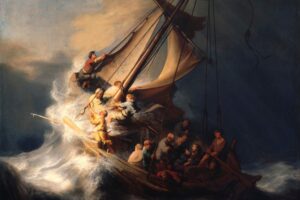
Rembrandt’s painting Storm on the Sea of Galilee tells a story of faith and hope. Especially when we feel lost...
12 October 2026
What’s the Future of Religion?
What’s the Future of Religion?
A Beginner’s Guide to Christianity
A Beginner’s Guide to Christianity
Mind-Blowing Statistics About Christianity You Need to Know
Mind-Blowing Statistics About Christianity You Need to Know
9055
Enter the Holyart world: $20 discount voucher valid on over 60,000 items
Come and discover Holyart, the largest e-commerce of religious articles in Europe and immediately receive a $20 voucher to use with your first purchase.
Check your mailbox: you will receive your discount within 5 minutes